Auditing the model sources
A complete archive inspection, missing simulation components, and a better-defined route to our first cat-circuit run.
The first source audit changes our implementation plan. The smaller study remains a useful physiological reference, but its deposited MATLAB source does not provide an identifiable driver for the simulation we intended to reproduce. We will start the execution work with the small regression model supplied by the Mozaik framework, then assess the full LSV1M cat visual-cortex model.
This entry records source inspection and benchmark selection. We have not run a neural simulation, reproduced a published result or tested a token controller. The downloaded sources, file inventories, hashes and open questions are preserved below.
What we checked
We read the 2019 study by Sedigh-Sarvestani, Palmer and Contreras, including its model methods and appendix, retrieved its complete Dryad archive, checked the archive against the repository's checksum, read every member to verify its ZIP integrity, and reviewed all 19 MATLAB source files. We also inspected the LSV1M v1.0 model release and selected Mozaik v0.4.0 framework files, including the small regression model and its reference outputs.
The archive checks establish which bytes we inspected and whether they match the deposit. They do not establish that the recordings are correctly calibrated or that a simulation reproduces biology. Numerical validation comes later.
What is in the first deposit
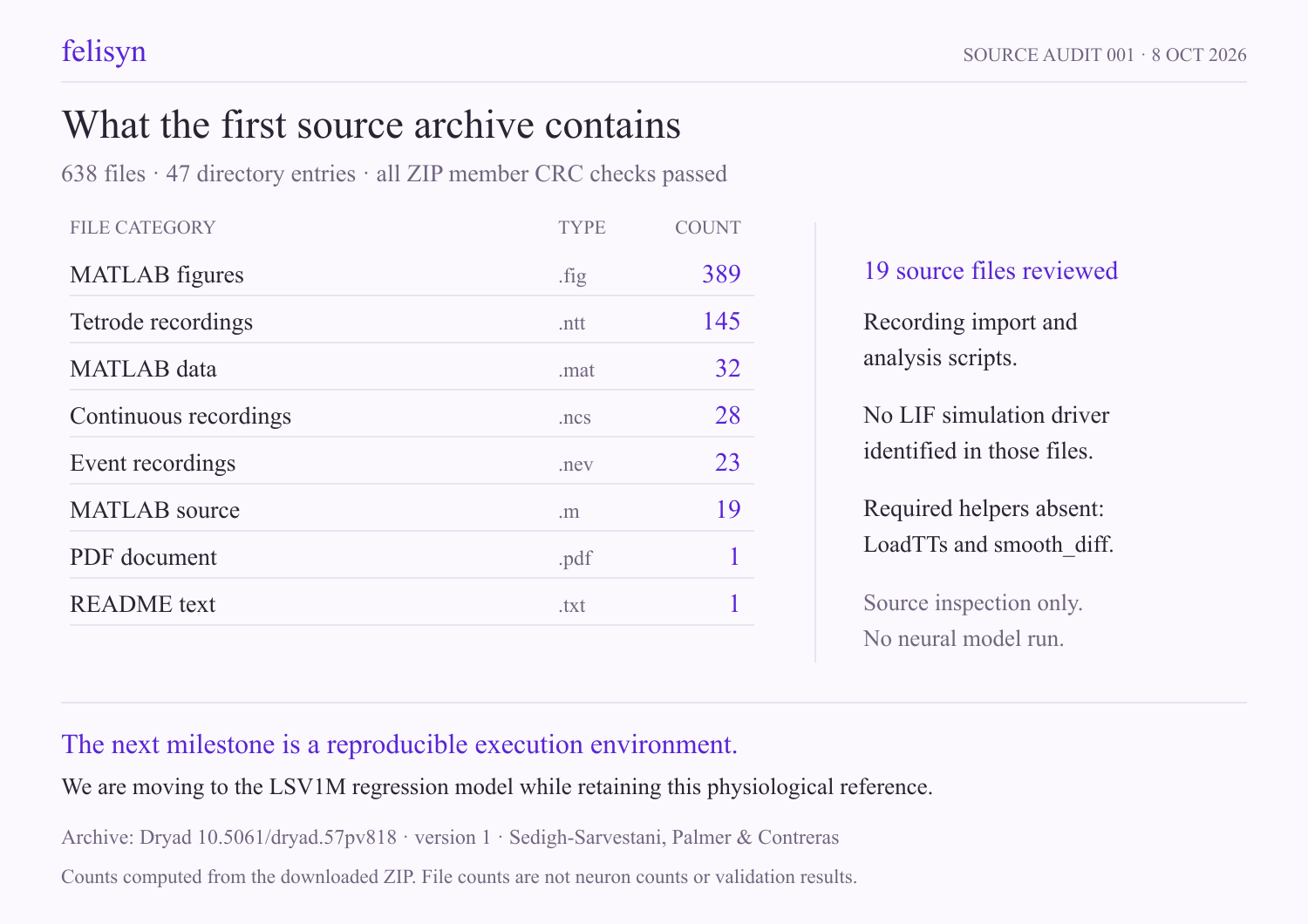
The Dryad dataset contains a 1,096,230,210-byte ZIP and a separate README. The ZIP has 638 files and 47 directory entries. Its files comprise 389 MATLAB figures, 145 tetrode recordings, 32 MATLAB data files, 28 continuous recordings, 23 event recordings, 19 MATLAB source files, one PDF and one text README.
The repository's MD5 checksum matches our download. We also computed SHA-256 for the archive and every regular member. All member CRC checks passed. The inspection script records how the inventory was produced.
The README directs readers to Main_Script.m. That script loads recorded LGN spikes and cortical membrane voltage, shifts spike timestamps, and estimates a jitter-corrected spike-triggered average. It is an analysis workflow. Our review of all 19 MATLAB files did not identify the leaky integrate-and-fire simulation driver for Figures 6–7 of the 2019 paper.
The supplied analysis workflow is also incomplete as a standalone package. FormatTTs.m calls LoadTTs, whose implementation is absent from the archive. The main script calls smooth_diff, also absent. Other routines call additional helpers and Neuralynx import functions that are not included. The entry point contains original Windows paths, and its jitter randomization has no explicit seed. We preserved the source unchanged and recorded these findings in the code review.
This is a finding about the inspected deposit. It does not establish that the authors' simulation code never existed or is unavailable elsewhere. Recovering it would require a further source or clarification. We have not contacted the authors.
The physiological model and its unresolved settings
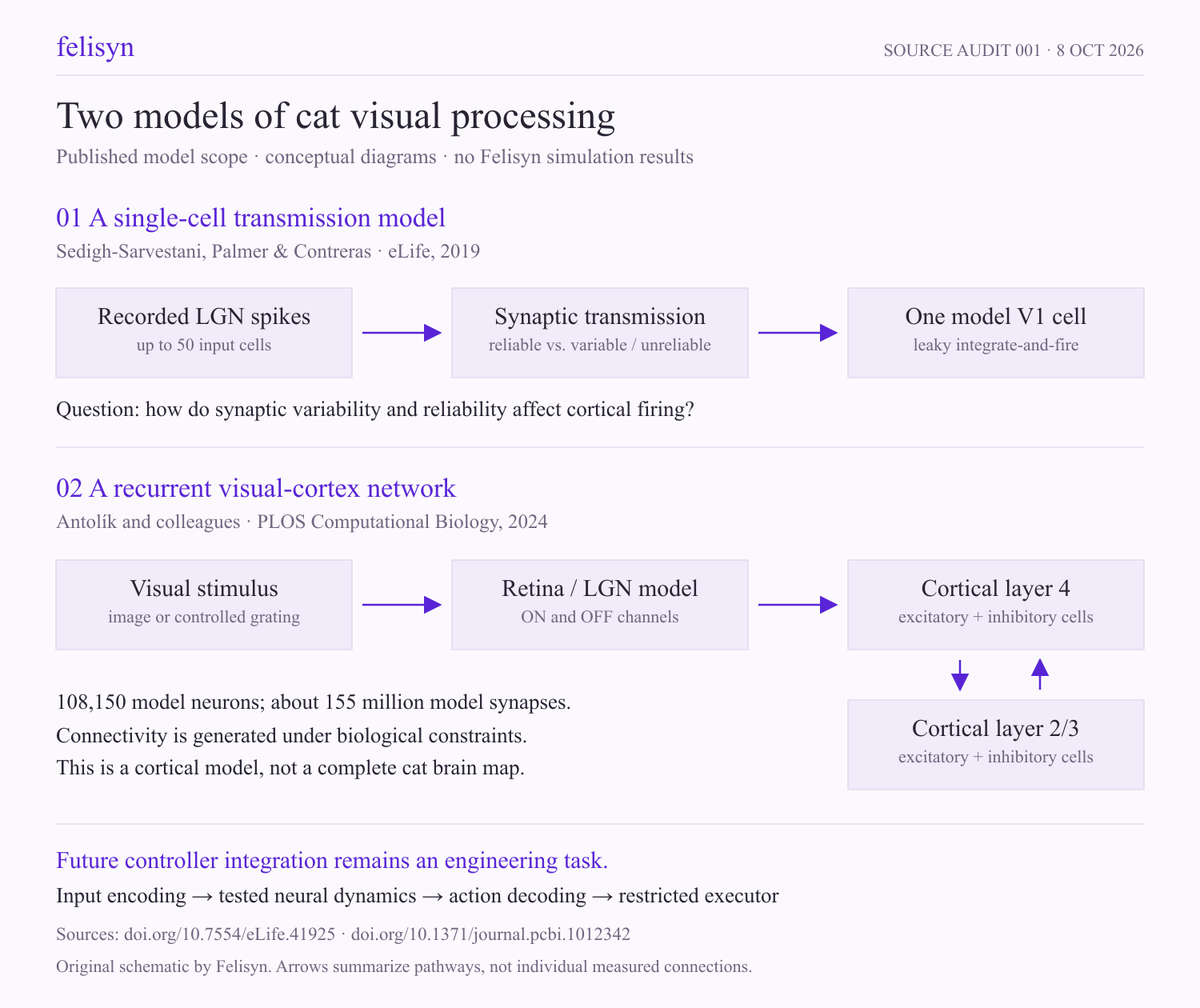
The 2019 paper describes one model cortical cell driven by recordings from up to 50 LGN cells. Its useful comparison is between reliable synapses and synapses with variable amplitudes and transmission failures, while controlling their mean conductance. This gives us a bounded question about how synaptic properties influence firing.
The methods specify a 0.1 ms step, an 89 s simulation and ten randomized assignments of synaptic properties. At 50 inputs, the paper reports mean firing rates of 1.8 Hz for reliable synapses and 7.8 Hz for unreliable synapses. These are the authors' simulation results, not Felisyn results.
One material ambiguity is the reset voltage: the methods give −60 mV, whereas Appendix 1 gives −65 mV. The selected input spike trains, assignment of empirical synaptic properties, random seeds and original output arrays must also be recovered or explicitly reconstructed. We will not choose settings simply because they make a plot look like the paper. The parameter audit separates reported values, derived values and unresolved choices.
Even a successful reproduction would establish a narrow transmission model. Recorded inputs do not themselves supply a visual encoder for arbitrary new scenes, and a single cortical cell does not provide a recurrent network or a cat's behaviour.
A more complete network source
Antolík and colleagues' 2024 model, LSV1M, provides a larger candidate. Its published scope includes retinal/LGN input and cortical layers 4 and 2/3. The paper reports 108,150 model neurons and approximately 155 million model synapses. Connections are generated under anatomical and functional constraints; they are not an individually traced whole-cat connectome.
We downloaded all 36 files in the LSV1M directory at the repository's v1.0 release, together with the repository license. All 37 downloaded blobs matched GitHub's Git object hashes, and we recorded independent SHA-256 hashes. The package contains network construction, parameters, stimuli, experiment runners and analysis/plotting code. See the versioned source and local inventory.
The release commit is dated November 2024, after the paper's August publication. We have pinned an identifiable release associated with the model; we have not established that it is the exact snapshot used for every published run.
The software environment needs reconstruction
The model's README reports an EPYC 7302 setup with 16 processes and 128 GB of RAM. It estimates about 90 minutes for the spontaneous-activity protocol and about ten hours for its grating/natural-image protocol. These are author-reported timings for that setup, not our measurements, a minimum specification or evidence of real-time operation.
There is no single consistent environment lock in the material inspected. The paper, installation instructions and continuous-integration workflow specify NEST 3.4, while requirements.txt lists NEST 3.1. The instructions require a custom PyNN branch and a compiled stepcurrentmodule; the dependency list instead names the ordinary PyNN 0.10.0 package. Some dependencies are fetched from moving branches. Mozaik's v0.4.0 tag also retains 0.1.0 in its package metadata.
These differences do not demonstrate that the model is broken. They mean that installing today's default packages is not a defensible reproduction procedure. We recorded the conflicts and observed dependency commits in the environment audit. Installing and testing a fixed Linux environment is the next work package.
The first executable benchmark
The Mozaik v0.4.0 source contains LSV1M_tiny_stepcurrentmodule, its saved reference outputs and tests. We preserved and hash-checked the complete small-model and reference-output directories, alongside the test implementation. The test compares spike-time vectors for six populations and voltage vectors for four cortical populations, using exact equality. The voltage checks cover up to 25 stored neurons per population.
Our first execution target will be those upstream tests, with their original criterion preserved. A mismatch will be recorded with the environment, first divergence and error magnitude. Any later tolerance will be a separately justified comparison, not a retroactive change to the original pass condition. Sources and criteria are recorded in the benchmark plan and framework inventory.
Passing this test would establish a software regression match for a small configuration. It would not reproduce the full paper or independently validate the model against a cat recording. The next biological target is the full model's spontaneous-activity statistics in Figure 4. Before running that comparison, we must obtain usable reference values and define the metric and tolerance. The paper's linked results portal was not accessible through our web reader during this audit; we have not recovered those full reference exports.
Keeping the eventual controller honest
The goal remains an autonomous system in which a tested cat-circuit model has a causal role in requests associated with a future Solana token. LSV1M offers recurrent dynamics and a defined visual-input pathway, making it the stronger candidate to investigate for that purpose. This is our engineering assessment, not a result reported by either study.
Several components would be ours: encoding an environment into stimuli, decoding model activity into requests, and deciding which requests an executor may carry out. A cat avatar's movements would also need a disclosed mapping unless a corresponding motor circuit were modelled. We would test these choices with replayed inputs, intact versus frozen or disconnected neural dynamics, and simpler comparison systems. A visually convincing display would not establish that the neural model controls the system.
A verified small simulation is therefore a useful first milestone. It is not a shortcut to a complete cat brain, biological agency or a useful financial strategy. Runtime, reproducibility and a measurable contribution from neural activity must determine the next design choices.
Reuse and evidence
The Dryad metadata declares CC0-1.0 for its deposit. The 2019 article is CC BY 4.0. The LSV1M repository carries an MIT-style license; the Mozaik framework carries CeCILL terms. We retained those notices. External import libraries, simulator components and third-party assets need their own version and reuse checks before redistribution. A paper's license does not cover every dependency.
The downloadable audit bundle includes our inventories, parameter and environment reviews, benchmark plan, inspection and figure-generation scripts, and graphics. It does not include the raw recordings or third-party code bundles. The sources remain available at their original repositories. Hashes identify exactly what we inspected; they are not evidence of biological validity.
Decision: retain the 2019 study as a physiological reference; use the small LSV1M regression configuration as the first execution target; defer any controller and token integration until the relevant tests exist. No model execution was performed in this audit.
References
- Sedigh-Sarvestani, M., Palmer, L. A. & Contreras, D. (2019). Thalamocortical synapses in the cat visual system in vivo are weak and unreliable. eLife, doi:10.7554/eLife.41925. Open full text.
- Sedigh-Sarvestani, M., Palmer, L. A. & Contreras, D. (2019). Associated dataset, version 1. Dryad, doi:10.5061/dryad.57pv818. Machine-readable metadata.
- Antolík, J. et al. (2024). A comprehensive data-driven model of cat primary visual cortex. PLOS Computational Biology, doi:10.1371/journal.pcbi.1012342. Open full text.
- CSNG-MFF. LSV1M v1.0 source snapshot and Mozaik v0.4.0 source snapshot.