A faster test that stopped at its own timing check
Note 20 found the cat circuit to be a faithful relay when its inputs are spaced apart. The next test removed the gaps, so recent inputs overlap inside the circuit, and asked whether the cortex's own connections change how they mix. Its rules, fixed in advance, included two stop checks. Both fired at 70 ms steps. The declared fallback, 105 ms steps, failed the timing check again, so the design ended before any main run. Its question is still open.
Note 20 found the cat circuit to be a faithful relay: with 210 ms gratings and grey gaps between them, it passes each new input on almost perfectly and carries no material trace of the previous one. Only a test in which inputs overlap inside the circuit can show whether its own connections change how recent inputs mix.
Protocol 021 was that test. Its steps follow each other without a gap, 70 ms each. Its question: do the connections inside the cortex change how much of the previous input ends up in the population code the decisions are read from?
Like every test here, its design and every rule were fixed and recorded with a hash before any of its runs. Those rules included two checks that stop the test if its conditions are not met. Both checks fired, the declared fallback failed too, and the design ended before its main runs. This note reports what happened. Its question has no answer yet.
How the test was built
- Conditions. The test compares intact networks with a matched lesion: every connection inside the cortex at zero weight, with the input from the thalamus scaled down so that layer 4 fires at the intact rate. A plain lesion, with the connections off but the input unchanged, was probed as well.
- The measure. It is the share of the previous input in the layer 4 population code, ρ₁, from a linear fit of that code on the current and recent inputs.
- The probe phase. Before the main runs, short probe runs on their own sequence set the remaining values by declared rules: the decoding windows, the input scale k, and the number of steps.
- The two stop checks:
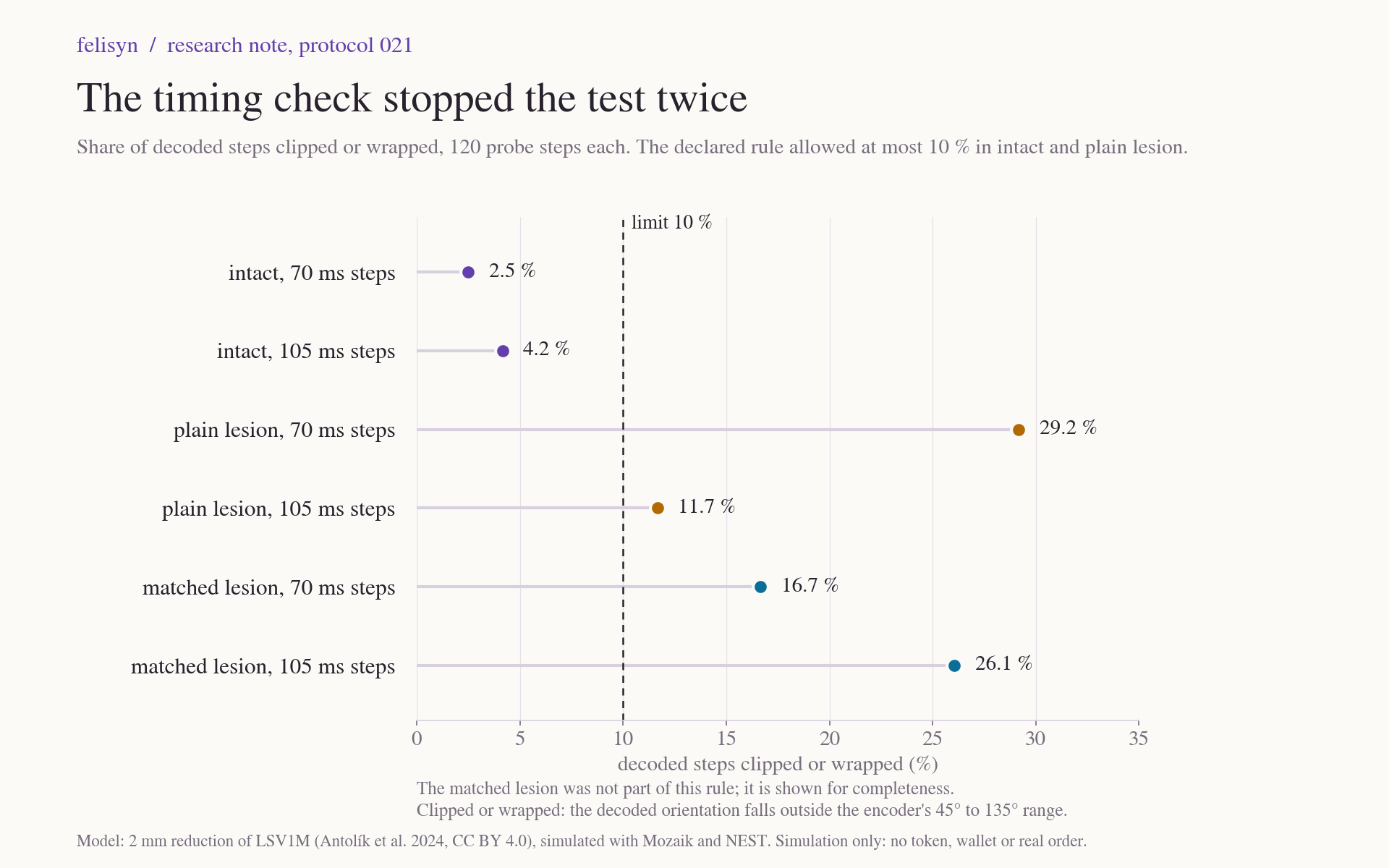
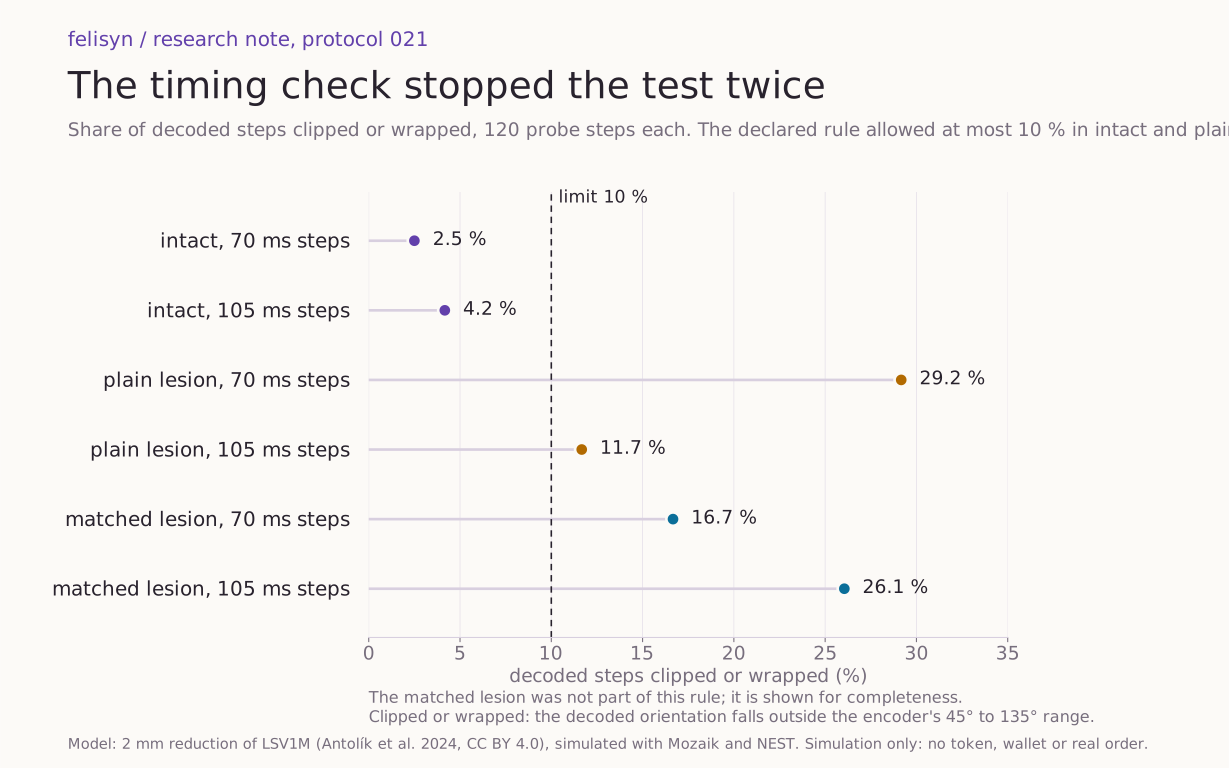
- timing: intact and the plain lesion must both decode, and in each at most 10 % of decoded steps may fall outside the encoder's range (clipped or wrapped). If not, the probe is repeated with 105 ms steps, and if that also fails, "the design is revised and reported as a failure of this timing";
- precision: at the cap of 900 steps, the projected 95 % half-width of the intact against matched difference must be at most 0.07, or the design is revised before freezing.
What happened at 70 ms
The first queue ran on our server on Saturday from 09:47 to 22:24 UTC, about 12.6 hours. It began with five short runs that checked an input cache. The cache gave identical spikes but failed its speed criterion, so by its rule every later run computed its own input. That changed no value. The probes and the calibration then took about 6.6 hours.
- Timing. The plain lesion's decoded angle fell outside the encoder's range in 29.2 % of steps. The matched lesion's did in 16.7 % of steps. It was not part of the rule, but it would have failed it too.
- Precision. The projected half-width at 900 steps was 0.108, against a limit of 0.07. At a matched firing rate, the matched lesion's population code is about four times weaker than the intact code, so its estimates are too noisy for the planned test.
- Calibration. The input scale came out at k = 0.51. Over steps 5 to 119 of the probe, the matched lesion fired at 0.804 of the intact rate, inside the declared ±20 % by 0.004.
The declared fallback: 105 ms steps
The spec's fallback repeated the probe with 105 ms steps. It ran overnight.
- Intact passed comfortably: 4.2 % of its steps clipped or wrapped.
- The plain lesion failed again, with 11.7 %. By the rule, the design ended there, before any main run.
- The calibration and the matched-lesion probe at 105 ms still ran, as pilot data for a revised design:
- Rate. The matched lesion, run at the first step's k = 0.53, fired at 0.73 of the intact rate, outside the declared ±20 %. The rule's second step then gave k = 0.54, with the mismatch reported. That k was not run.
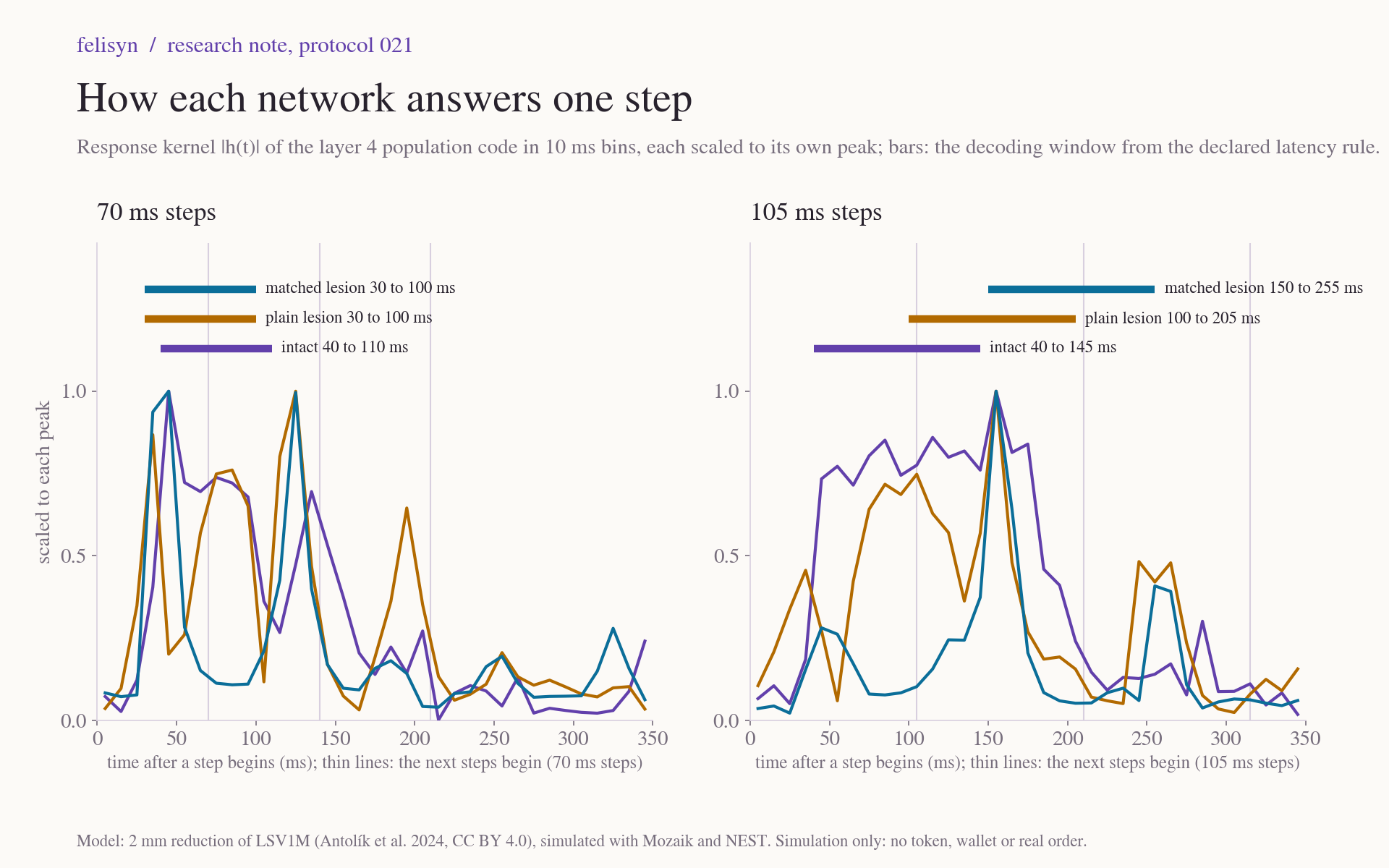
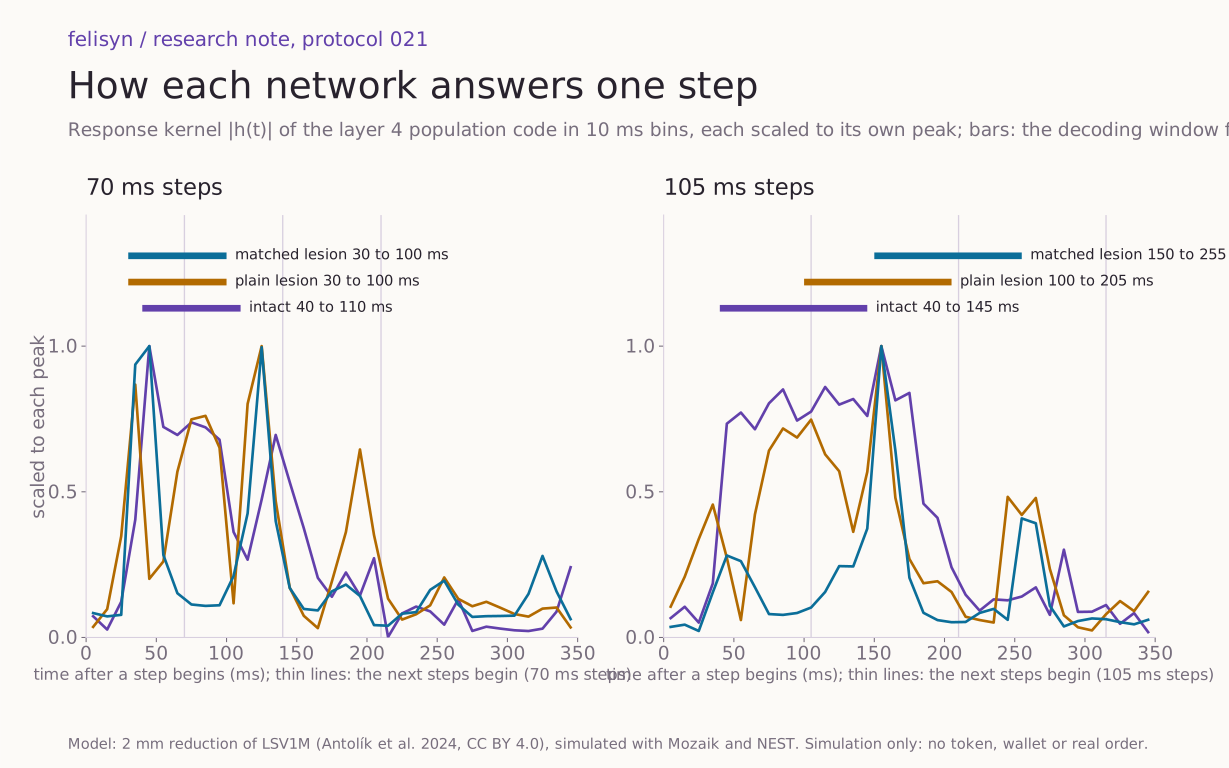
- Window. The declared latency rule set its response time at 150 ms, so its window ran from 150 to 255 ms, mostly inside the next step.
- Code. 26.1 % of its steps were clipped or wrapped, and its population code was about six times weaker than the intact one.
- Precision. Its projected precision at 900 steps, 0.067, would formally have met the limit. But a window that reads mostly the next step makes that number meaningless, so even a narrower test of only the main conditions would have failed at this timing.
We changed no rule after seeing a result, and we report the probe's own estimates of ρ only as pilot values in the evidence package. A probe is there to set values and run checks, not to answer the question.
A bug caught before it mattered
Repeating the probe at 105 ms exposed an assumption in our analysis code. It placed each step's onset by rounding the step length to whole 10 ms bins. That is exact for 70 ms steps, but at 105 ms every onset would have drifted 5 ms per step, and the decoding windows would have come out wrong.
- A test written first reproduced the error: a synthetic response with a 40 ms latency came out at 90 ms.
- After the fix, each onset sits in the bin that contains it. Rerun with the fixed code, the 70 ms analysis reproduced its earlier output byte for byte.
- The bug never touched a result.
What it means
- Without its intracortical connections, layer 4 fires about seven times as often (48 Hz against 7 Hz).
- At 105 ms steps, all three networks give their largest response about 50 ms after the next step begins.
- Intact also answers within about 40 ms and holds that answer through the step.
- The plain lesion answers during the step as well, but in a different direction in the population code from its largest response.
- The declared latency rule asks when the response first reaches half its peak in the peak's own direction. It therefore gave 40 ms for intact, 100 ms for the plain lesion and 150 ms for the matched lesion (Figure 2).
- So the rule put the lesions' windows largely in the next step, and their decoded orientation fell outside the encoder's range too often for a clean reading at these step lengths.
- What the kernels mean is still open. While designing the next protocol, a review found that this kernel mixes the input's contrast with its orientation, because the encoder sets the contrast from the signal's size. The next design separates the two.
- The matched control is weak. Scaling the input down until layer 4 fires at the intact rate leaves a population code about four times weaker, too noisy for the planned precision.
- So the test as designed cannot answer its question at these timings. We say so rather than loosen its rules after the fact.
What did not happen
No rule was changed, no main run was made, and protocol 017's frozen pieces are untouched. The failed design and all its probe data are published as they are.
Next
A revised design will be declared, with its own rules, before any of its runs, and will say what changed and why. Its choices may use what the probe measured about timing and noise, but never the probe's pilot estimates of ρ.
Limits
- One 2 mm reduction of the model, one network instance in the probes, one encoder, one decoder, and two step lengths.
- Probes are short: 120 steps each.
- Everything here is simulation. The market is synthetic, and nothing has financial meaning.
Evidence and sources
- Probe 021: the probe phase, with:
- the design as declared;
- the analyses at 70 ms and 105 ms, and the 105 ms timing check;
- every run's receipts, the code, the manifest and the evidence archive.
- Decisions 020, the results behind note 20.
- Model: Antolík et al. (2024), CC BY 4.0; LSV1M v1.0 (MIT); Mozaik (CeCILL). The reduction, the probe runs, the analysis and the figures are ours.