Two gratings at once: the circuit did not simply add them
Protocol 022's plaids pilot has run. Shown two drifting gratings on top of each other, one network instance of the cat circuit did not answer with the sum of its answers to each grating alone: a grating at right angles suppressed the response to the preferred one, the stronger of two gratings dominated, and the decision readout, applied offline, leaned further toward the stronger grating than the sum of its single readouts. The declared outcome is GO. As declared before the runs, this describes the whole model circuit, input stage included, and does not show that the cortex's own connections compute it.
Note 20 found the cat circuit to be a faithful relay when it sees one input at a time. A controller that receives two signals at once needs a further answer: does the circuit pass on the sum of the two, or does one signal suppress or outweigh the other?
Protocol 022 asked this with plaids. A plaid is two drifting gratings shown on top of each other. If the circuit were a relay, its response to a plaid would be the sum of its responses above the grey level to each grating alone. As in Felisyn's other declared protocols, the design, the measures and the reading of each possible outcome were fixed and recorded with a hash before any run.
The headline: in this one network instance, the model circuit did not simply add the two gratings.
- A grating at right angles lowered cells' response to their preferred grating.
- When the two gratings differed in contrast, the cells preferring the stronger grating kept most of their response, and those preferring the weaker one lost most of theirs.
- Note 18's frozen readout, applied offline, leaned further toward the stronger grating than the sum of its readouts of the two gratings alone.
The declared outcome is GO. As the design said before the runs, this is a property of the whole model circuit, including the stage that feeds the cortex, and it does not show that the cortex's own connections compute it.
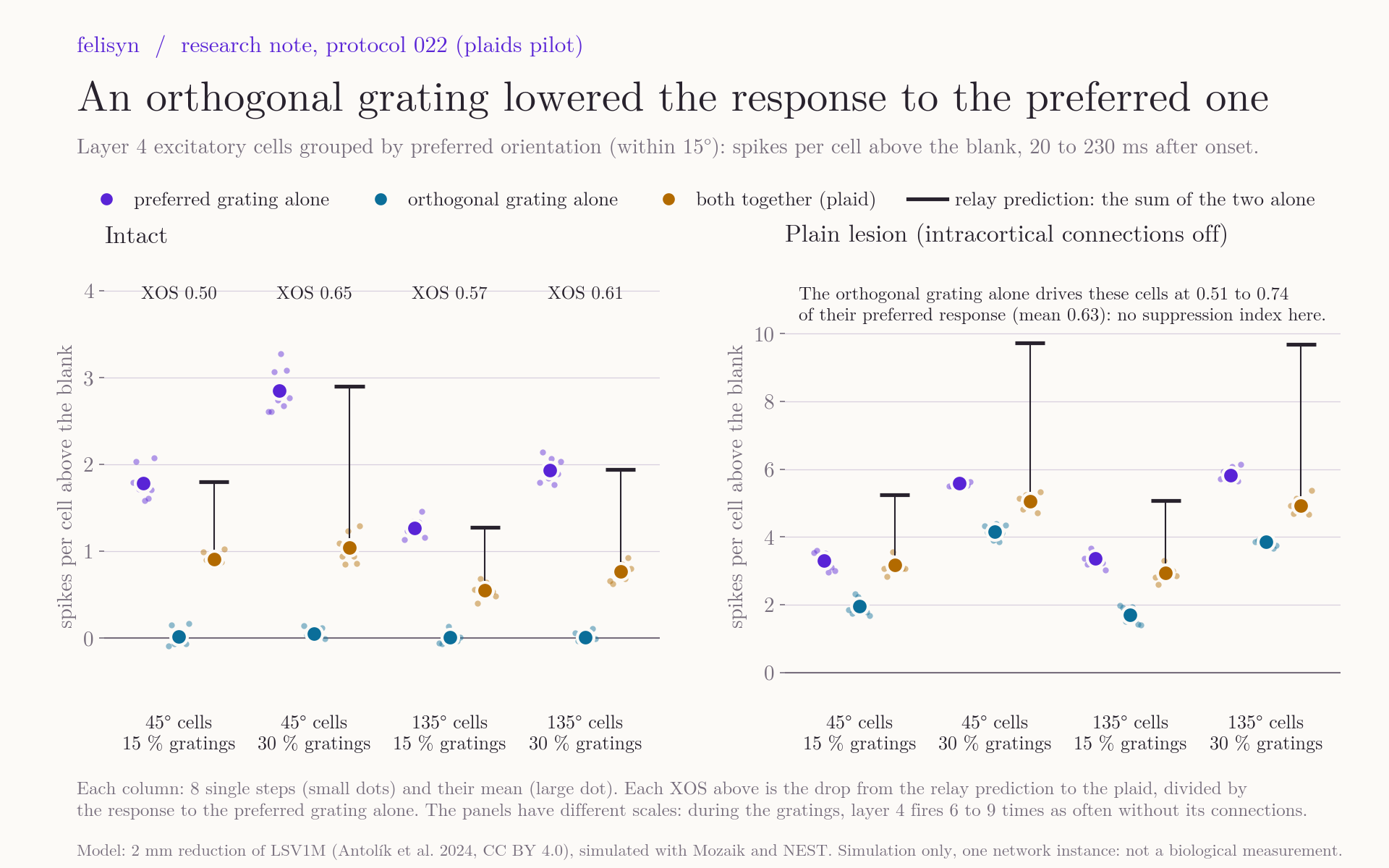
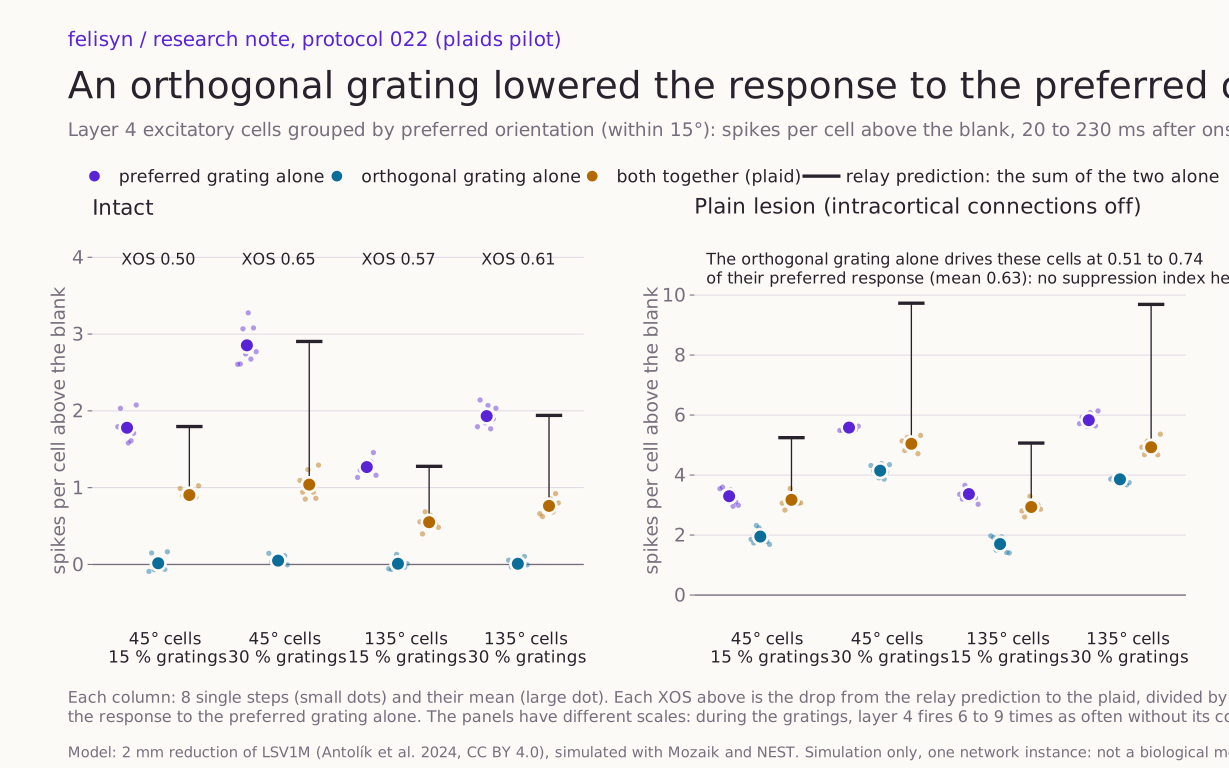
What was asked
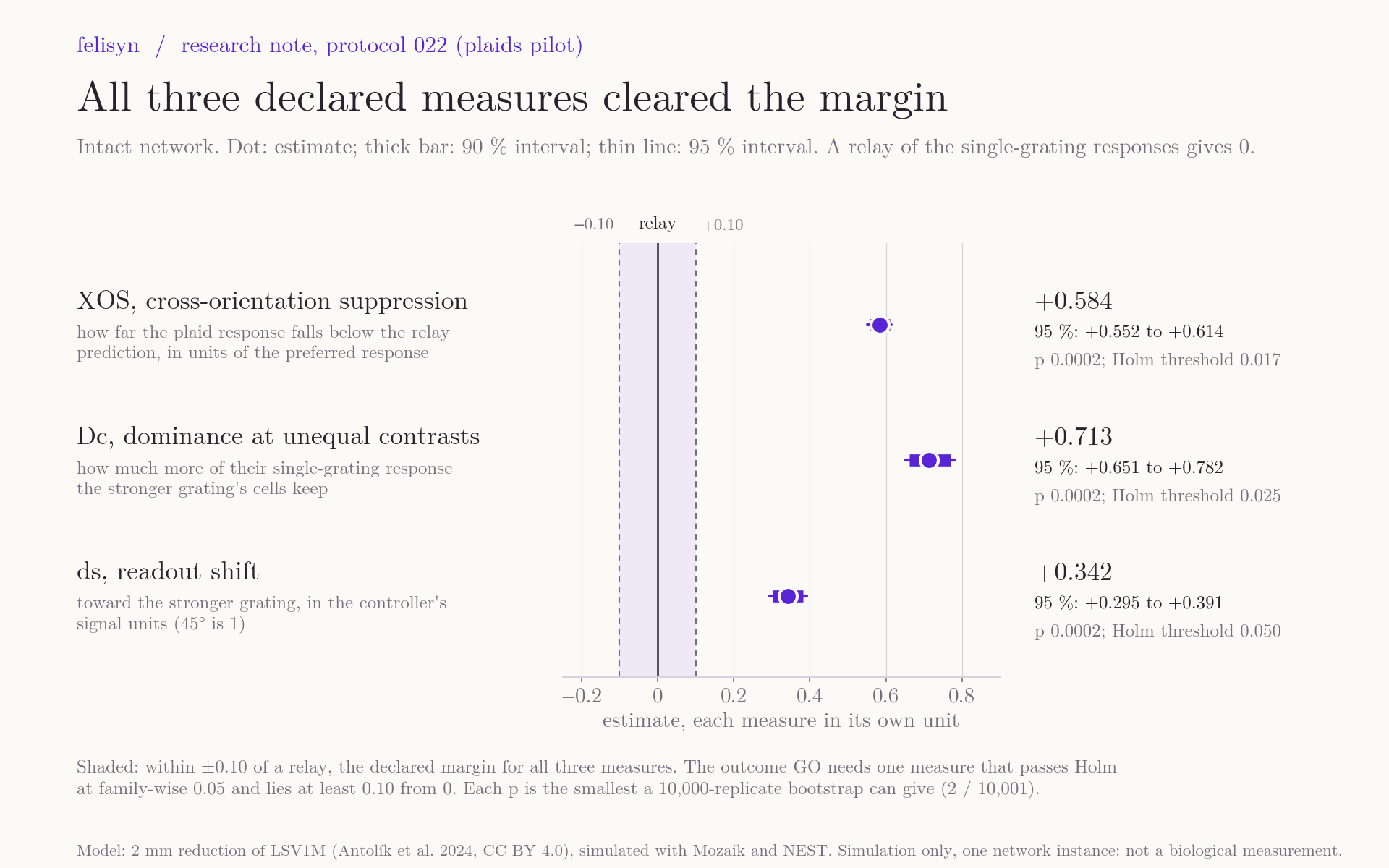
Three measures answer the question in the intact network. Each is exactly 0 for a relay, a circuit whose answer to a plaid is the sum of its own answers to each grating, so differences in tuning or overall gain cancel out. Anything non-linear that acts when both gratings are present, such as saturation in the input stage or in the cortex, can move them away from 0. Each had to lie at least 0.10 from 0 to count.
- Suppression (XOS). Take layer 4 cells that prefer one of two gratings at right angles. Show their preferred grating alone, the other grating alone, and both together at the same contrast. XOS is how far the response to both falls below the sum of the two single responses, in units of the response to the preferred grating. The reported XOS is the mean over the two groups of cells (45° and 135°) and two contrasts (15 and 30 %). It is valid only where the other grating alone barely moves these cells. This effect is known as cross-orientation suppression.
- Dominance (Dc). In a plaid whose two gratings differ in contrast, do the cells that prefer the stronger grating keep a larger share of their single-grating responses than the cells that prefer the weaker one? A group's share is its response to the plaid over the sum of its responses to the two gratings alone. Dc compares the two shares as (stronger − weaker) / (stronger + weaker), so 0.10 means the stronger group keeps about 22 % more. The reported Dc is the mean over the two plaids of unequal contrast. A gain shared by both groups cancels out.
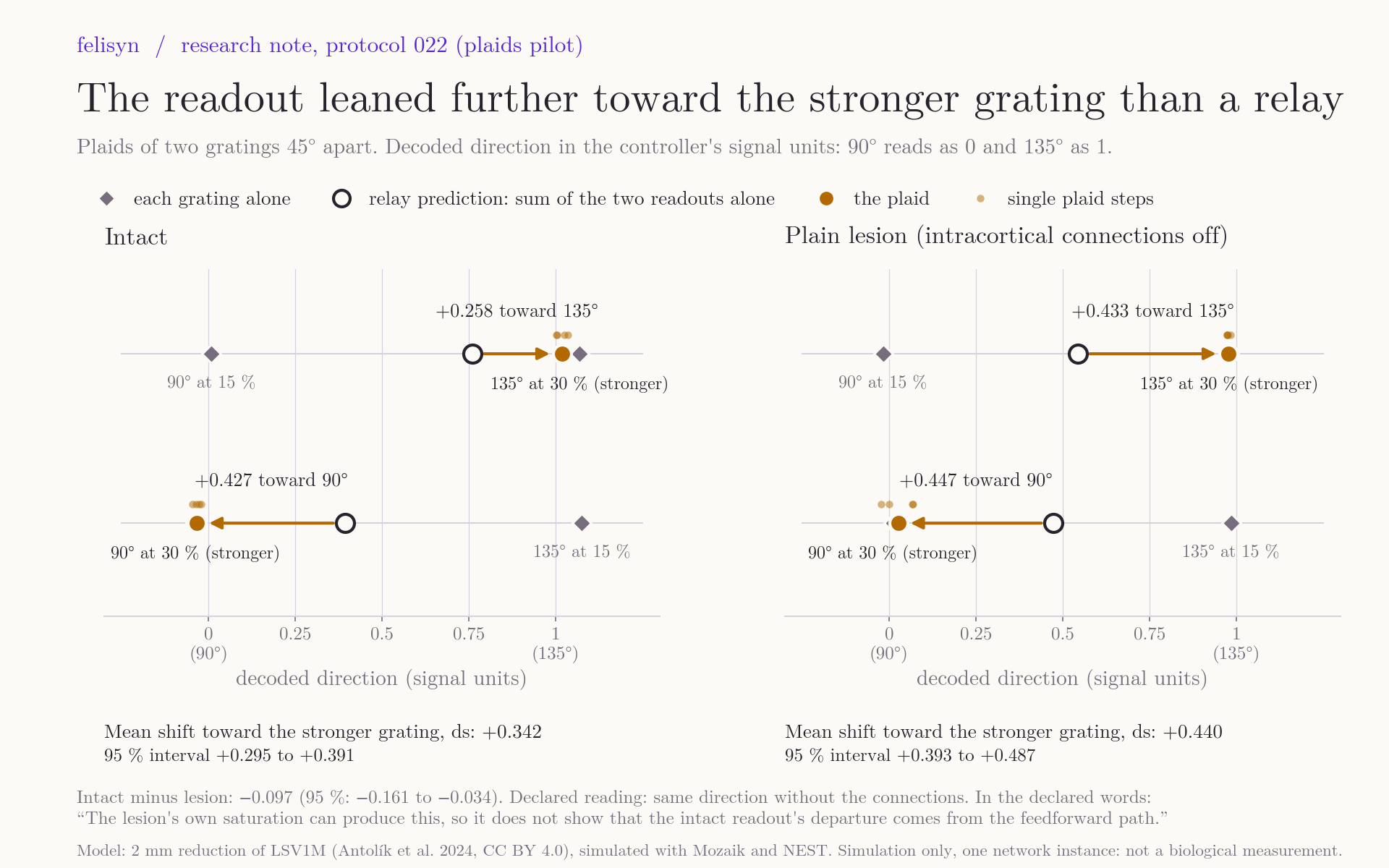
- Readout shift (ds). For a plaid of two gratings 45° apart, does the readout from note 18 point further toward the stronger grating than the sum of its readouts of the two gratings alone? It is measured in the decision signal's units, where 45° of orientation is 1 and the threshold for a buy or sell request is 0.25.
How the test was built
- One network, two versions. Network instance A of the 2 mm reduction of the published model, run twice on the identical stimulus sequence and the identical input spikes:
- intact, with its published connections;
- plain lesion, with all twelve connection pathways inside the cortex at zero weight and its input unchanged.
- Stimuli. Gratings drifting at 2 Hz, with the timing of the decision tests: 210 ms of grating or plaid, then 147 ms of grey. There were 15 conditions: grey, single gratings at 15, 30 and 60 % contrast, and plaids whose two gratings were at most 30 % each. In all, 96 analysed steps and 35 seconds of model time, in an order fixed in advance.
- What is counted. For the group measures, the spikes of layer 4 excitatory cells whose preferred orientation lies within 15° of a grating's (721 to 1,071 cells per group), 20 to 230 ms after each onset. The readout is note 18's decoder, unchanged.
- Uncertainty. Intervals come from resampling whole steps, 10,000 times. A correction for testing three measures (Holm's method) covers them together.
- The outcome rule, in this order: NOT INTERPRETABLE if declared checks fail; GO if at least one measure passes the correction and lies at least 0.10 from 0; RELAY-LIKE if all three are shown to lie within ±0.10; INCONCLUSIVE otherwise. Each outcome came with a fixed text, written before the runs.
- A GO was expected from the input stage. The design said so in advance. The stage that feeds the cortex is not linear. Responses in the model's LGN, the stage between the retina and the cortex, saturate, and the synapses from the LGN onto layer 4 weaken strongly with use. Both act before the cortex, identically in both versions. So a GO describes the whole model circuit, not the cortex alone.
- Calibration. On synthetic pilots built from the noise of earlier runs, a pure relay produced a false GO in at most 3.55 % of cases.
The design changed twice under review before it was declared. A first question for protocol 022, whether the cortex holds a step's input, was withdrawn and never run. A first plaids draft was then replaced, after a review found that its comparison with the lesion would only restate that the lesioned layer 4 is untuned and saturated. The revision that ran was declared on 26 October at 23:15 UTC, before any plaid run.
What ran
On 27 October, after a failed check and its fix (below), the design was frozen at 18:39 UTC, and the queue started on our research server 26 seconds later. Each job ran once and ended normally:
- intact: 2 h 54 min;
- plain lesion: 2 h 50 min;
- connection export: 16 min. This job wrote out all 4,306,718 connections onto layer 4 for a declared follow-up (see Next). Its seven structural checks pass.
The frozen analysis then ran once, on 28 October from 04:26:23 to 04:26:39 UTC. Its checks passed:
- no refusals;
- the LGN spike trains were identical between the two runs for all 3,600 LGN cells;
- both runs reproduced earlier reference responses at 30 % contrast within the declared bands.
The result
The declared outcome is GO: all three measures pass the correction, and all three lie well beyond the 0.10 margin.
| Measure | Estimate | 95 % interval |
|---|---|---|
| Suppression, XOS | +0.584 | +0.552 to +0.614 |
| Dominance, Dc | +0.713 | +0.651 to +0.782 |
| Readout shift, ds | +0.342 | +0.295 to +0.391 |
In plain numbers:
- Suppression. Take the cells that prefer the 45° grating, at 30 % contrast. Their own grating alone raised them by 2.85 spikes per cell above the grey level, and the grating at right angles alone by 0.05. A relay would answer both together with 2.90. The plaid gave 1.04. Across both groups and both contrasts, XOS ran from 0.50 to 0.65.
- Dominance. In the plaid of 45° at 30 % with 135° at 15 %, the cells of the stronger grating kept 0.76 of the sum of their single-grating responses, and the cells of the weaker grating 0.10. In the mirror plaid it was 0.85 against 0.17.
- Readout. Alone, the 135° grating at 30 % read as 1.07 and the 90° grating at 15 % as 0.01. Each readout has a direction and a strength, and the sum of these two points to 0.76. The plaid read 1.02, close to its stronger grating alone. In the mirror plaid the sum points to 0.39, and the plaid read −0.03, close to the 90° grating alone at 30 %, −0.04.
- Decisions, a side measure. Applied offline, note 18's decision rule put 7 of the 40 plaid steps on a different side (buy, sell or hold) from the one the sum of the single readouts predicts. This measure has no role in the outcome.
The declared GO text, as the analysis wrote it:
In this one network instance the intact circuit combined two superimposed gratings differently from a relay of its single-grating responses, by at least the declared margin: an orthogonal grating lowered layer 4 cells' response to their preferred grating (cross-orientation suppression), XOS = 0.584 (95 % interval 0.552 to 0.614); at unequal contrasts the cells preferring the stronger grating kept more of their single-grating response than those preferring the weaker one (winner-take-more, as normalisation predicts), Dc = 0.713 (95 % interval 0.651 to 0.782); the controller's frozen readout of a plaid of gratings 45 degrees apart pointed 0.342 signal units further toward the stronger grating than the sum of its readouts of the two gratings (ds = 0.342, 95 % interval 0.295 to 0.391). This is a property of the whole model circuit (input stage and cortex) at these contrasts and this timing, and the input stage alone was expected to produce part of it. It does not show that the intracortical connections compute it: the shared input stage is non-linear, and suppression or dominance of the afferent drive shows in spikes only in tuned cells, which need the connections. A confirmatory protocol on fresh network instances follows, declared before its runs.
What the lesion can and cannot say
The plain lesion was there to ask whether the cortex's own connections matter. As declared, its answer is limited.
Without its connections, layer 4 is a different circuit. Its excitatory cells fired 6.4 to 8.7 times as often over the stimulus steps (each grating or plaid and the grey that follows it), and about 10 times as often in the grey steps. They also largely lost their orientation preference: the grating at right angles alone drove them at 0.63 of their response to the preferred one (Figure 1, right). So the lesion cannot show suppression or dominance in group spikes. The lesion's own values of these measures are in the evidence package, and as declared they are not read. The declared text:
Without the connections layer 4 cells respond to both gratings (the orthogonal grating alone drives them at 0.625 of the preferred response), so the plain lesion cannot show suppression or dominance in group spikes; this pilot does not answer whether the connections compute the intact network's XOS or Dc.
The readout leaned the same way without the connections, by 0.440 (95 % interval 0.393 to 0.487). The declared reading is "same direction without the connections":
In this one network instance, without the intracortical connections (at a 7 to 8 times higher layer 4 rate and without its tuning), the readout departed from a relay in the same direction, ds_les = 0.440. The lesion's own saturation can produce this, so it does not show that the intact readout's departure comes from the feedforward path.
The difference has no reading. The intact lean was 0.097 smaller than the lesion's (95 % interval 0.034 to 0.161). The reading that the connections change the readout needed a difference of the opposite sign and a lesion readout within ±0.10 of a relay, so the difference is reported without one. Figure 3 in the evidence package shows both readouts.
So how the input stage and the cortex's own connections each contribute is still open.
A bug caught before the freeze
Before the freeze, a check on the research server (tier 2, in the protocol's terms) had to confirm that the new stimulus code builds the declared frames with the pinned simulation software.
- The first attempt failed, at 14:37 UTC on 27 October. Two checks passed, but all four stimulus checks stopped with the same error, raised inside the simulation framework.
- The cause was in the check script, not in the stimulus code or the design. The script loaded the two stimulus modules from their files but never registered them in Python's registry of loaded modules, where the framework looks them up. The real runs load the stimulus code normally and would not have hit this.
- The fix registers each module before running it, the standard recipe, and changes nothing else in the script. The spec, the stimuli, the analysis and the queue did not change. An out-of-date test of the freeze step was fixed at the same time, with no assertion changed.
- The rerun passed at 18:24 UTC: all six checks in 68.6 seconds. An earlier rerun, from 17:55 to 18:16 UTC, never reached the check because the connection to the server dropped. The design was frozen 15 minutes after the pass.
The failed script, both receipts and the fix record are published.
Next
- A confirmatory protocol on fresh network instances, declared before its runs, as the GO text says. It takes over each triggering measure exactly as defined here, with the same 0.10 margin. Its size will come from the noise measured in this pilot, never from these estimates.
- The declared follow-up. It rebuilds, offline, the synaptic input each layer 4 cell received from the LGN and from the cortex's own excitatory and inhibitory cells, using the exported connection lists and the recorded spikes. Its code is developed and checked on earlier runs before it reads any pilot data, and it must then reproduce this pilot's lesion run before any reading is made. It is the part designed to estimate how much of the suppression the input stage carries, and it cannot change this pilot's outcome.
- Status on 28 October: the confirmatory protocol has not been written yet, and the follow-up has not been run.
Limits
- One network instance, one stimulus order, one timing and one readout. The intervals cover this instance's step-to-step noise only. How other instances behave is the confirmatory protocol's question.
- A reduced model, not a cat. This is a 2 mm reduction of the published model. Its LGN stage saturates less than a cat's and has no pooled suppressive field, so its split between input stage and cortex describes the model only.
- Only layer 4. As declared, only layer 4 was compared, because layer 2/3 falls silent without the connections. All three measures rest on layer 4: its groups of cells and a readout of its excitatory cells.
- Onset responses. Counts in the 210 ms window after each onset are dominated by the onset response, so they cannot be compared with steady-state measurements in cats.
- Contrasts. Contrasts were 15 to 60 %, with each grating in a plaid at most 30 %.
- One pattern per plaid. Both gratings started at the same phase, so each plaid was one fixed pattern, and it fell differently on the two groups of cells. About three quarters of the 45° cells, but only a third of the 135° cells, sat where the two gratings add in phase, and in the 135° cells the response to a plaid changed with that phase. So the values for each group hold for this layout only. As the spec also notes, each plaid moved as one pattern, at the velocity its two gratings set together, and the readout reads orientation, which repeats every 180°.
- The readout shift rests on two plaids. ds averages two plaids of 4 steps each, and they gave quite different values, 0.26 and 0.43. These two plaids also had the least balanced stimulus history in the design: the steps before them had a mean summed contrast of 22.5 % and 48.75 %. Refitting with the previous step's contrast as a covariate changed ds by only 0.002.
- The lesion changes the operating point. It removes all twelve connection pathways together, so inhibition and recurrent excitation are not separated here. The declared texts speak of a "7 to 8 times" higher layer 4 rate; this run measured 6.4 to 8.7 times over the stimulus steps (grating plus the grey that follows) and 10.2 times in the grey steps.
- p values at their floor. Each p of 0.0002 is the smallest that 10,000 resamplings can give. It means only that no resampling crossed 0.
- The noise model. A declared check of the noise model flagged 5 of the intact run's 855 pairs of condition and summary, and none of them enters the three measures. The check is reported and never acted on.
- A gap in the output. The spec lists a third form of the suppression index as a side measure. The analysis output has no summary of it with an interval, although its value for each group and contrast follows from another table there.
- Not a controller test. These runs involved no decision pipeline: the decision sides above were computed offline from the readout. A controller fed two signals at once would need its own declared encoder.
- Simulation only. In the spec's words: "Neither outcome is a claim about cat V1." Nothing here is biological validation.
Evidence and sources
- Plaids 022: the results package, with:
- the results and the analysis log;
- the queue log and every run's receipts;
- the tier 2 fix record, with both receipts and the failed script;
- the structural checks of the connection lists;
- the manifest and the evidence archive.
- The run exports and connection lists, about 160 MB, are too large for this site. Their sizes and SHA-256 are in data-sha256.txt.
- Protocol 022, public copy: the frozen design, with three lines that hold private strings redacted and every other file as frozen. It holds the spec as declared, its contract, the analysis code and the manifest that the launcher checked before the runs.
- Protocol 017, whose timing, readout and decision rule this test reuses.
- Model: Antolík et al. (2024), CC BY 4.0; LSV1M v1.0 (MIT); Mozaik (CeCILL); NEST (GPL). The reduction, the runs, the analysis and the figures are ours.