The circuit's first decisions: a faithful relay
The decision test frozen in note 18 has run. At 210 ms gratings separated by grey gaps, the cat circuit passes each new input on almost perfectly and carries no material trace of the previous one into its next decision, in both network instances. Without its cortical connections, the decoded signal is compressed toward the middle and decisions lean slightly away from the previous input, so the cortex shapes the readout even at this timing. As declared, this design stops here; the next one was pre-registered before this result and is already running.
Note 18 built Felisyn's first decision pipeline around the cat circuit and froze a test before it ran. A synthetic market signal becomes a drifting grating, the model responds, and a fixed decoder turns its spikes into buy, sell or hold requests for a simulated executor. The question was whether the circuit carries the previous input into its next decision, or simply relays the current one.
The headline: at this timing the circuit is a faithful relay. Both intact network instances pass the current input on almost perfectly, and neither carries a material trace of the previous input into the next decision. The declared reading is "no carry-over", and, as the project plan requires, this design stops here. The cortex is not idle, though. With its connections switched off, the decoded signal is compressed toward the middle, and decisions lean slightly away from the previous input.
What ran
Three runs of a 2 mm reduction of the published model, one after another on our server, each on the same declared sequence of 120 market steps:
- intact A: the published connectivity, 3 h 38 min;
- intact B: another random instance of the same network, 4 h 12 min;
- feedforward only: all 12 projections inside the cortex at zero weight, so layer 4 hears only the thalamus, 5 h 8 min.
Each step shows a grating for 210 ms and then 147 ms of grey. Every run ended normally, and every export passed the protocol's frozen input checks. The frozen analysis then ran unchanged in 12 seconds. It decoded every step, wrote the decision logs, and replayed each log exactly from an independent recount of the spikes.
The result
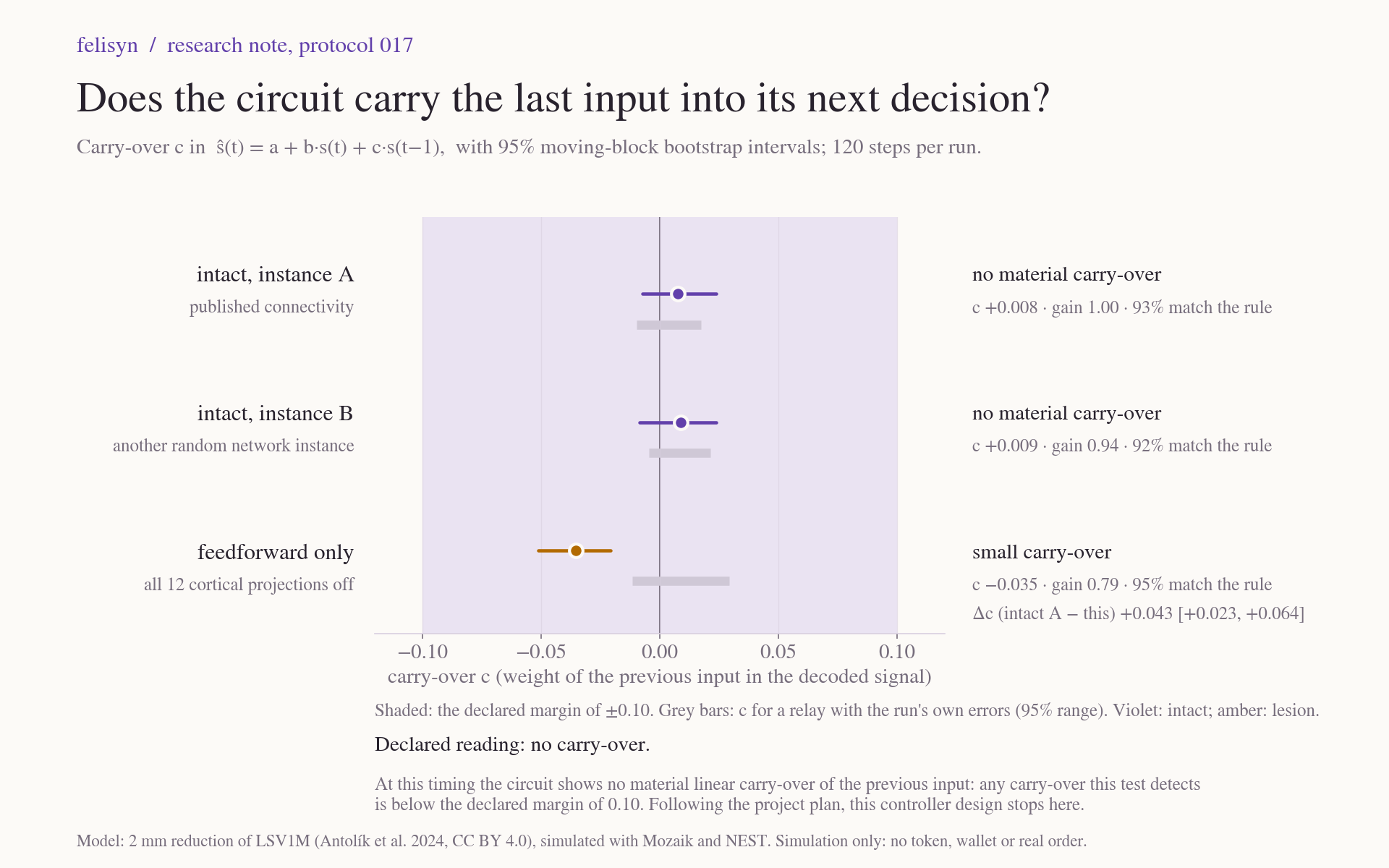
The measure is the carry-over c in the fit ŝ(t) = a + b·s(t) + c·s(t−1): how much the previous input moves the current decision signal. A carry-over smaller than 0.10 in either direction does not count as material.
| Run | Carry-over c | Reading |
|---|---|---|
| intact A | +0.008 (−0.007 to +0.024) | none material |
| intact B | +0.009 (−0.009 to +0.024) | none material |
| feedforward only | −0.035 (−0.051 to −0.021) | small |
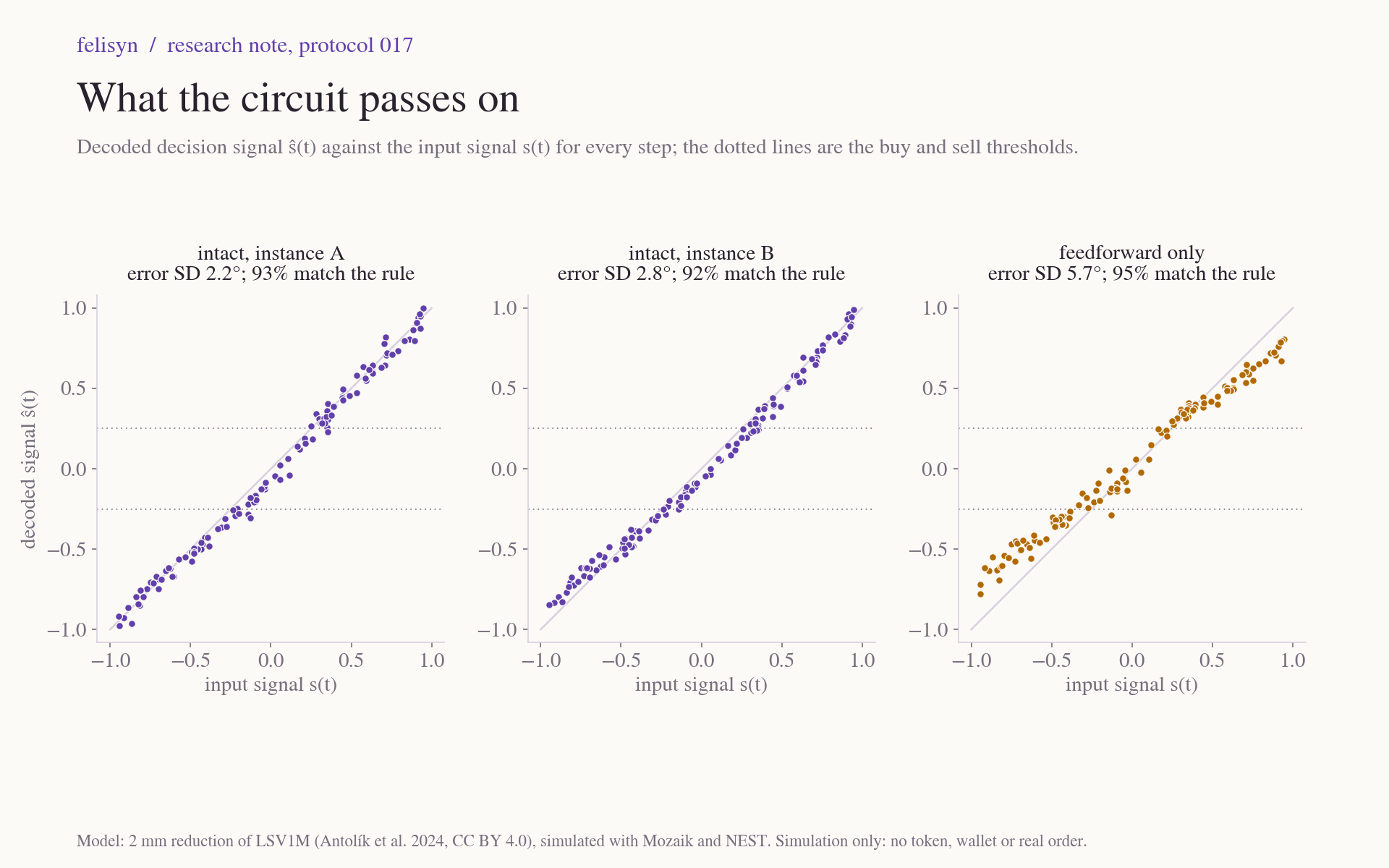
Both intact intervals include zero and lie within ±0.025, a quarter of the margin. The decoded signal follows the input closely, with a gain of 1.00 and 0.94 and orientation errors of 2.2° and 2.8°. 92 to 93 % of the requests match those of a noiseless rule.
What changes without the cortex
Comparing intact A with the lesion on the same steps:
- Gain: without its cortical connections, the decoded signal is compressed toward the middle, with a gain of 0.79 instead of 1.00.
- Errors: its orientation errors are larger, with an SD of 5.7° against 2.2°. That is almost entirely the compression: around its own fitted line, the scatter is about the same as intact. Its requests still match the rule on 95 % of steps.
- History: decisions lean slightly away from the previous input, c = −0.035. The effect is small, but its interval excludes zero. With the cortex, the history weight is 0.043 more positive and the net carry-over is near zero. These data cannot say which mechanism produces the lesion's repulsion.
So with its cortical connections, the circuit keeps the decoded signal at full scale and leaves no net carry-over.
One caution matters for the next step. Without its cortical connections, layer 4 fired about seven times as many spikes per decoding window, so this comparison mixes the loss of the cortex with a very different firing regime.
Two network instances
The two intact instances made the same request on 93 % of steps, within the range expected if their errors were independent.
Their remaining errors correlate at 0.44. Their thalamic input noise was entirely different, so that shared part comes from what the two have in common: the stimulus sequence, the decoder and the model's fixed structure. One example is a small decoding bias at particular orientations.
What it means
As declared, at this timing the circuit relays the input, and the design stops. As note 18 anticipated, this was not a surprise, given how faithfully the circuit relayed orientation in calibration.
The next design was pre-registered before this result existed:
- The design. The steps are 70 ms long with no grey gaps, so successive inputs overlap inside the circuit.
- The comparison. Each intact network is set against a lesioned copy whose input is scaled down until layer 4 fires at the intact rate.
- The record. Its plan and its branching rule were recorded with timestamps between 23:22 and 00:01 UTC, before any of these runs had been analysed, and every reading here leads to it.
- Status. Its preparatory runs (an identity check, probes and calibration) started on our server this morning.
Limits
- A 2 mm reduction of the model, one timing, one encoder and one decoder.
- "No carry-over" means no material linear carry-over at this timing, not that the circuit has no memory.
- Open loop: decisions do not feed back into the market or the stimuli.
- The market is synthetic and every outcome is simulated, so nothing here has financial meaning.
Evidence and sources
- Decisions 020: the results package, with the results, the decision logs of intact A, intact B and the lesion, the analysis log, the export hashes, the manifest and the ZIP.
- Protocol 017: the frozen test, with its contract and analysis code.
- Model: Antolík et al. (2024), CC BY 4.0; LSV1M v1.0 (MIT); Mozaik (CeCILL). The reduction, the pipeline, the runs and the figures are ours.