Preparing the full-model experiment
We traced a compatibility flag through the framework's history, checked 82 parameter sets and fixed the protocol for a 40.32-second cat visual-cortex simulation. The full run remains pending.
Two preparatory steps are complete: we investigated a remaining compatibility question and froze the configuration, measurement rules and launch package for the full cat visual-cortex experiment. All 82 parameter-schema checks passed. The full-model neural run has not started.
This continues the recording-configuration audit and analysis check on saved small-model data. Our candidate is the published LSV1M visual-cortex model, not a reconstruction of an entire cat brain. Its first full experiment will ask whether the declared software configuration produces finite spontaneous-activity statistics and how those values compare with the paper's printed results.
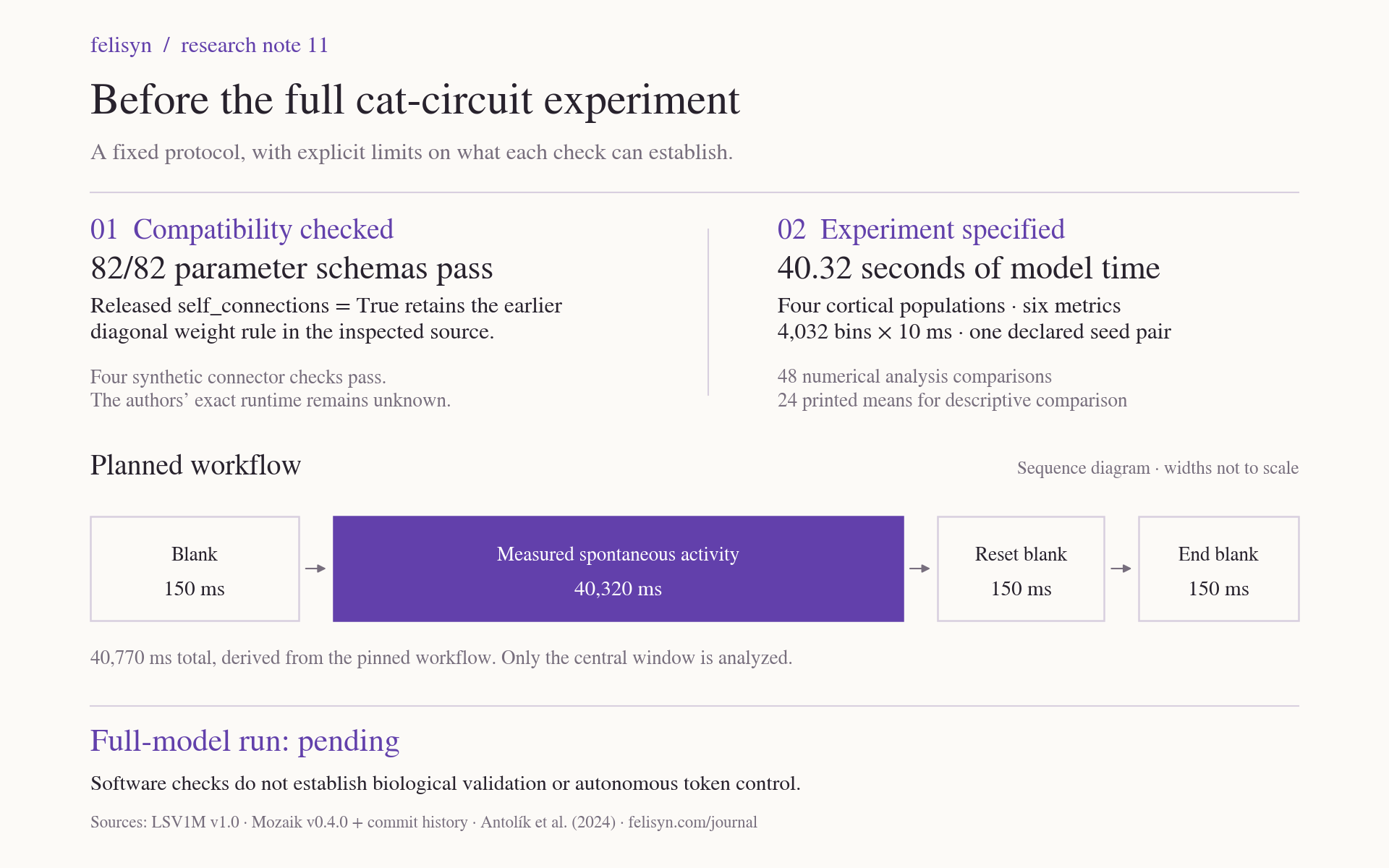
Step one: resolve the self-connection choice
The released parameters explicitly set self_connections=True, while the earlier archived parameter record lacks that field. Treating an absent field as False would silently change the candidate model. We inspected the framework's history to establish what the setting actually does.
The field was introduced in Mozaik commit c8261569, dated 21 October 2024. The earlier weight calculation returned the evaluated weights without suppressing the diagonal. The new code adds a conditional: when the flag is false and source and target have the same population name, it sets the diagonal weight to zero.
We therefore retain the released True setting. It preserves the earlier unsuppressed diagonal weight rule in the inspected code. Four synthetic tests invoke the unchanged historical and current methods with controlled weights, covering both flag values and both same-population and cross-population cases. All four behave as expected. These tests establish a local code relationship; they do not identify the exact framework revision used for the authors' archived run or prove equivalent full-network dynamics.
We also loaded the released full parameter tree and checked 82 parameter sets against the actual pinned framework classes. All passed. This catches missing, extra or incorrectly typed fields without allocating the full network. Network construction, memory use and full simulation behavior remain untested.
Step two: fix the experiment before running it
The versioned run contract hashes the unchanged model files, records the runtime source commits and fixes the following choices.
| Setting | Declared choice |
|---|---|
| Model | LSV1M v1.0, published cat primary visual cortex model |
| Recording recipe | General param/defaults, matching the four inspected archived cortical recorder definitions |
| Experiment | Dedicated spontaneous-activity factory; one trial labelled 0 |
| Measured duration | 40,320 ms; no additional trimming |
| Integration and analog sampling | 0.1 ms and 1 ms respectively |
| Correlation bins | 4,032 bins of 10 ms |
| Populations | Excitatory and inhibitory cells in layers 4 and 2/3 |
| Effective random seeds | PyNN 5; Mozaik 513 |
| Parallel execution | 16 MPI ranks, one thread per rank |
| Reference comparison | 24 printed means; descriptive differences only |
The released mpi_seed=1023 field is required by the model schema but is not forwarded as mozaik_seed by this controller. The pinned framework consequently uses its default of 513. We preserve the released fields and document that behavior. Trial 0 is a stimulus label, not evidence of an independent replicate.
Inspecting the workflow exposed a timing detail: it presents a 150 ms blank before measurement, then adds a 150 ms reset blank and a 150 ms terminal blank at the end. The expected total is therefore 40,770 ms, while the analyzed window stays 40,320 ms. This is derived from code, not measured full-run output. The diagram makes those intervals explicit without inventing an activity trace.
What counts as a result
There are three separate decisions. Execution succeeds only if the process completes, saves its raw datastore and reports no explosion. Numerical analysis must then provide 48 finite, agreeing comparisons: mean and standard deviation for six metrics across four populations, with unchanged input-file hashes. Finally, the reference comparison reports the differences between 24 measured means and the paper's printed labels.
That final comparison deliberately has no biological pass threshold. A value lying within half the final printed unit is a rounding-proximity observation, not an equivalence test. The paper's across-neuron standard deviations cannot simply become tolerances for independent runs. Full-precision reference arrays, exact historical execution details and the previously reported 4.09-versus-3.56 nS conductance discrepancy remain unresolved.
A successful run would support a bounded claim about this declared reconstruction. Independent biological validation and later causal controller tests would still be required. Those controller tests must show that changing neural inputs changes outputs and that disrupting the circuit changes the resulting actions, with simpler baselines for comparison.
Software checks and corrections
The prepared launcher checks model-file hashes, source revisions, installed versions and parameter schemas before starting. The runtime audit passes 78 checks, including 187 installed Python source files matching their corresponding checkouts. Ten contract tests and twelve metric tests also pass. The command is accepted by the actual workflow argument parser.
The initial runtime check assumed editable installations and rejected three import locations. The existing environment uses copied packages. We corrected the check to compare installed source-file hashes and retained the failed receipt alongside the passing audit. Source inspection also caught and corrected a nonexistent datastore getter in the new wrapper before execution. These were preparation errors, not neural results.
The generalized analysis script was rechecked against the previously saved 105 ms small-model recordings: 48 of 48 finite comparisons passed, with the source datastore unchanged. The full-window comparator rejects that short fixture. Passing software checks cannot turn a small-run result into a full-model result.
The current four-CPU, approximately 8 GiB host is rejected by the launcher's declared resource floors. Its preflight receipt explicitly records that no simulation started. The full launch wrapper has not been exercised end to end at full scale.
The next run and its budget
We propose a temporary, separate 16-vCPU, 128-GiB machine with 400 GiB storage. DigitalOcean's listed Memory-Optimized Regular rate is USD 1 per hour, checked on 13 October 2026. A six-hour allocation would cost about USD 6 before tax and extras; setup time, availability and actual runtime remain uncertain. Provider pricing.
The simulation process has a three-hour timeout. That timeout does not stop cloud billing: the temporary machine must be removed after results are exported and verified, or an extension approved. Powered-off machines still incur charges under the provider's billing rules. No additional paid host has been created or resized for this work.
The next milestone is the actual full-model execution and its measured resource use, followed by the declared analysis. It is still pending compute approval. The eventual autonomous Solana controller remains a later milestone.
Evidence and sources
- Complete package, reproduction instructions, run contract and SHA-256 manifest.
- Compatibility checks, 22-test log, runtime audit, saved-data regression and short-window rejection.
- Antolík et al. (2024), LSV1M v1.0, Mozaik v0.4.0 and its historical connector change. Original source licenses accompany the retained files.