Rehearsing the full-model setup in a clean environment
A clean Ubuntu 24.04 environment on our research server rebuilt the pinned simulation software in under 20 minutes and passed the upstream small-model regression test. We also found a launch requirement, a likely timing risk and a likely mismatch in the frozen recording plan.
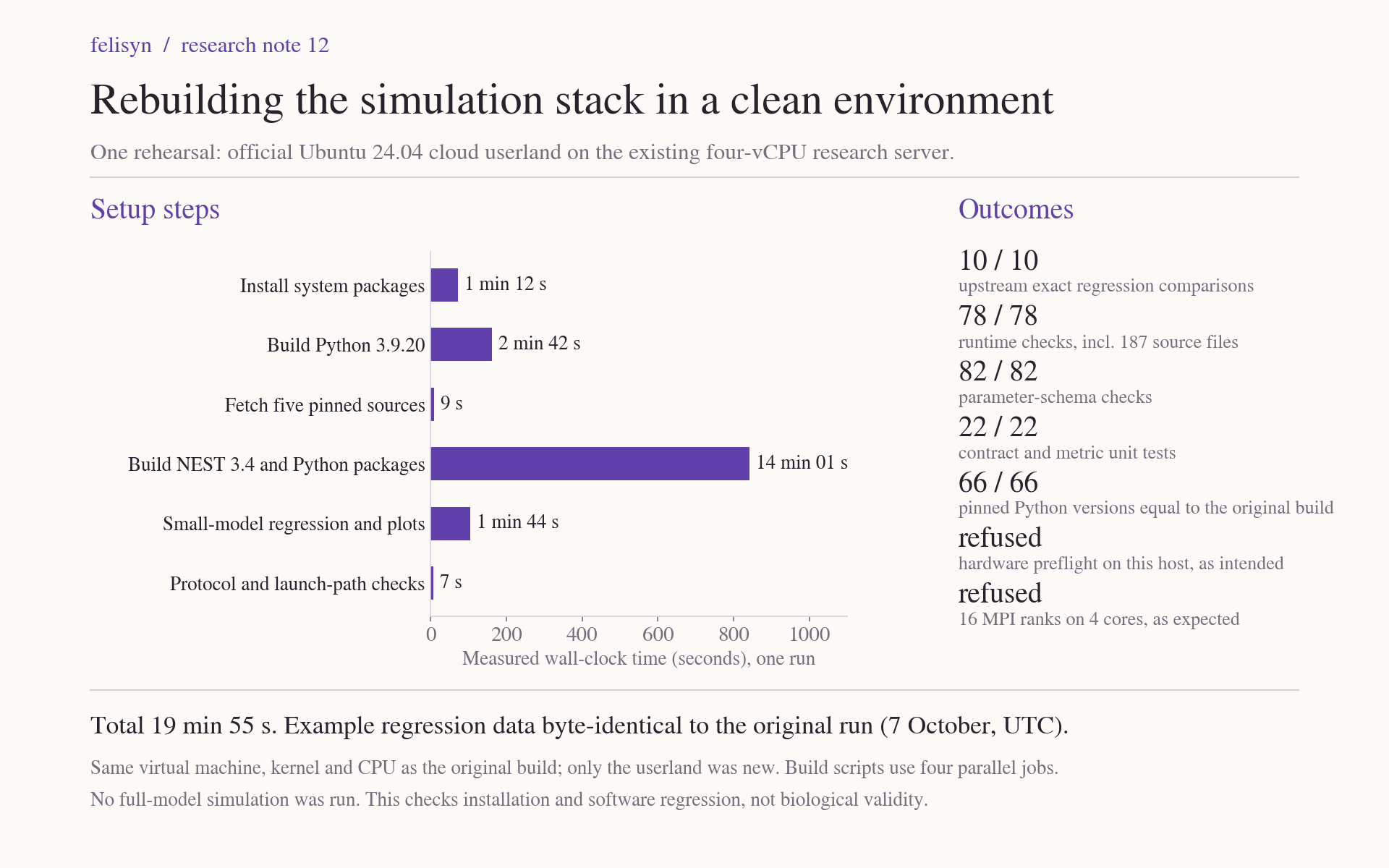
To prepare the full cat visual-cortex experiment, we rehearsed its setup in a clean environment. The documented installation recipe ran unchanged inside a fresh Ubuntu 24.04 userland: a clean copy of the operating system's files and packages, running on our existing server's kernel. All 21 steps ended as expected. The rebuilt software passed all 10 exact-equality checks of the upstream small-model regression test, which compares spike times and voltages of a tiny test network with stored reference values. It also passed the frozen full-model protocol's software preparation checks. The protocol's hardware preflight refused this small server, as intended. The full-model simulation itself has still not been run.
This continues note 11. That note froze the experiment. Its protocol package recorded that the consolidated installation recipe had not yet been run end to end on a second clean machine. This rehearsal covers a clean userland on the same machine, not a second machine. The model is the published LSV1M visual-cortex circuit, not a whole cat brain.
How the rehearsal worked
We downloaded the official Ubuntu 24.04 cloud-image root filesystem (serial release-20261017), verified its signed checksum list and its SHA-256, and unpacked it on our existing four-vCPU research server. A small driver script then ran the installation inside that clean userland, isolated in private mount and process namespaces. The server's own working installation was not used or touched.
Inside, the script followed the published recipe exactly as written: system packages, Python 3.9.20, the five pinned source revisions, NEST 3.4 with its extension module, and the locked Python packages. It then ran the original small-model regression test and the full-model protocol's preparation commands as an unprivileged user. The recipe's scripts ran unchanged. The isolated environment needed two adaptations: a copy of the server's DNS settings, and mounts of /proc, /sys and /dev.
Results
The build finished in about 18 minutes. The 21 steps inside the clean userland took 19 minutes 55 seconds, after about half a minute to fetch, verify and unpack the image.
| Check | Result |
|---|---|
| Upstream small-model regression test | 10/10 exact-equality checks |
| Saved recordings versus the original run | 48/48 segment files decode to identical content: 2,208 spike trains, 144 analog signals |
| Runtime audit | 78/78 checks, including 72 package versions and 187 installed source files |
| Parameter schemas | 82/82 |
| Contract and metric unit tests | 22/22 |
| Model files and source revisions | 37 files and 5 revisions match the contract |
| Pinned Python packages | 66/66 identical to the original build |
| Hardware preflight | Refused this small host, as intended; no simulation started |
The derived diagnostics and example figure data are byte-identical to the original run. All 48 segment files, which hold the recordings, differ at the byte level yet decode to identical values. We did not investigate why. Three other output files also differ: the run log and the run-information file, which contain dates and times, and the datastore's recordings index, which we did not decode. Among the key build dependencies (GCC 11.5, CMake 3.28, Open MPI 4.1.6, GSL, Boost, glibc and others), only the kernel headers changed version. Across all system packages, 50 shared packages resolved to different versions and 52 packages of the original provider image were absent, because Ubuntu's repositories are not frozen.
What the rehearsal changed for the full run
A machine running the frozen launcher unchanged must expose 16 cores to the operating system. By default, Open MPI 4.1.6 creates one launch slot per processor core that the virtual machine presents, not per hardware thread. The frozen launcher uses a plain mpirun -np 16 without the options that change this (--oversubscribe, --use-hwthread-cpus). On the small server, which presents four single-threaded cores, a 16-process launch was refused with "not enough slots", while a 4-process launch started and loaded the simulator. By the documented default, a machine that presents 16 virtual CPUs as 8 cores with 2 threads each would also refuse the frozen launch. This server could not test that case. We drafted a check of the presented processor layout for any future host; it is not yet published or used.
Physical cores may matter for the time limit. The released model notes report about 1 h 30 min for the spontaneous protocol with "16 processes on a EPYC 7302 CPU with 128 GB of RAM", using the spontaneous recording settings. The authors' Slurm launch script asks for one process per physical core. On many cloud providers one virtual CPU is one hardware thread, so a 16-vCPU machine may have only 8 physical cores; this must be confirmed for any specific machine. Sharing cores could push the run toward protocol 006's 3-hour limit. That is an inference, not a measurement.
A documentation correction. One preparation script changes into the model folder before writing its report. The protocol's instruction to write compatibility-check.json with a relative path therefore places it inside model/. This affects neither the launcher, which uses absolute paths, nor the contract's file hashes. The published protocol package stays unchanged; we will use absolute paths.
A correction to the recording plan
While preparing the run, we also found that the frozen protocol's recording settings may not match the paper's Figure 4, which shows the spontaneous-activity statistics. Protocol 006 uses the model's general recording settings because they match the authors' archived run. The paper's supplementary S5 Table, however, lists a separate and much larger recording set for spontaneous activity, for example 3,467 rather than 152 spike-recorded layer 4 inhibitory neurons. The released instructions also run the spontaneous protocol with the model's dedicated spontaneous settings (param_spont). The authors' archive lists a Figure 4 image under the same general-settings run, which does not settle the question. Note 13 sets out the evidence on both sides and checks the exact counts on our own model build.
By our reading of the pinned code, recording settings choose which neurons are sampled and should not change the simulated network. We have not yet compared two full runs, and the larger set records far more data. Protocol 006 stays unchanged as a record; a new, versioned protocol will carry the corrected comparison.
Limits
The rehearsal used the same virtual machine, kernel and processor as the original build. It shows that the recipe works from a clean userland, not that it works on different hardware or a second machine. Ubuntu's package repositories are not frozen, so a later installation can resolve newer system packages. The timings are single observations. The small regression test cannot tell us anything about the full model's dynamics, memory or run time.
Compute status
The larger temporary machine proposed in note 11 was not used, and no new machine will be rented. The next step is a feasibility probe on the existing four-vCPU research server. It runs the unchanged network with the spontaneous recording settings and a short spontaneous segment, using a large swap file, and measures the full network's memory use and simulation speed. Protocol 006 cannot run there unchanged: its resource floors, 3-hour limit and plain 16-process launch all exclude this server. Any full run there would use a new, versioned protocol with host-specific execution settings for resource floors, time limit and process layout, and we will report whether those settings change the results. We will decide after the probe whether such a run is practical. No full-model result, biological validation or controller work exists yet.
Evidence and sources
- Rehearsal package, README, result summary and SHA-256 manifest.
- Driver and in-userland script, step receipt, regression record, runtime audit, environment comparison and decoded-recording comparison.
- Cloud-image checksum record with the signed checksum list.
- Antolík et al. (2024), LSV1M v1.0, Mozaik v0.4.0, Open MPI 4.1
mpirundocumentation. Licences: paper and supplements CC BY 4.0; LSV1M MIT; Mozaik CeCILL.