The plaids result holds over six fresh instances: confirmed
Protocol 023 revision 2 reran the confirmatory plaids test with a paired rule: every network instance is run twice on identical inputs and analysed only if the two runs agree on every spike train. Six fresh instances of the cat circuit model settled with an agreeing pair, after one slot fell to the reserve and the rule absorbed two one-off faults of the kind that had ended the first attempt. The declared outcome is CONFIRMED on all three measures: on average over the instances, the model circuit did not answer two superimposed gratings with the sum of its answers to each alone, in the pilot's direction and beyond the declared margin. As declared, this describes the whole model circuit on its one orientation map, input stage and cortex together, in simulation; it does not show that the cortex's own connections compute it, and it is not biological validation.
Note 22 found, in one network instance of the 2 mm cat circuit model, that the circuit did not answer two superimposed gratings with the sum of its answers to each alone. Note 24 reported the confirmatory test of that pilot ending at its first run: a declared check caught a one-off execution fault on the laptop, and the declared outcome was NOT INTERPRETABLE, with a new declared revision promised.
This is that revision, and it has run to the end. The declared outcome is CONFIRMED, on all three measures, over six fresh network instances.
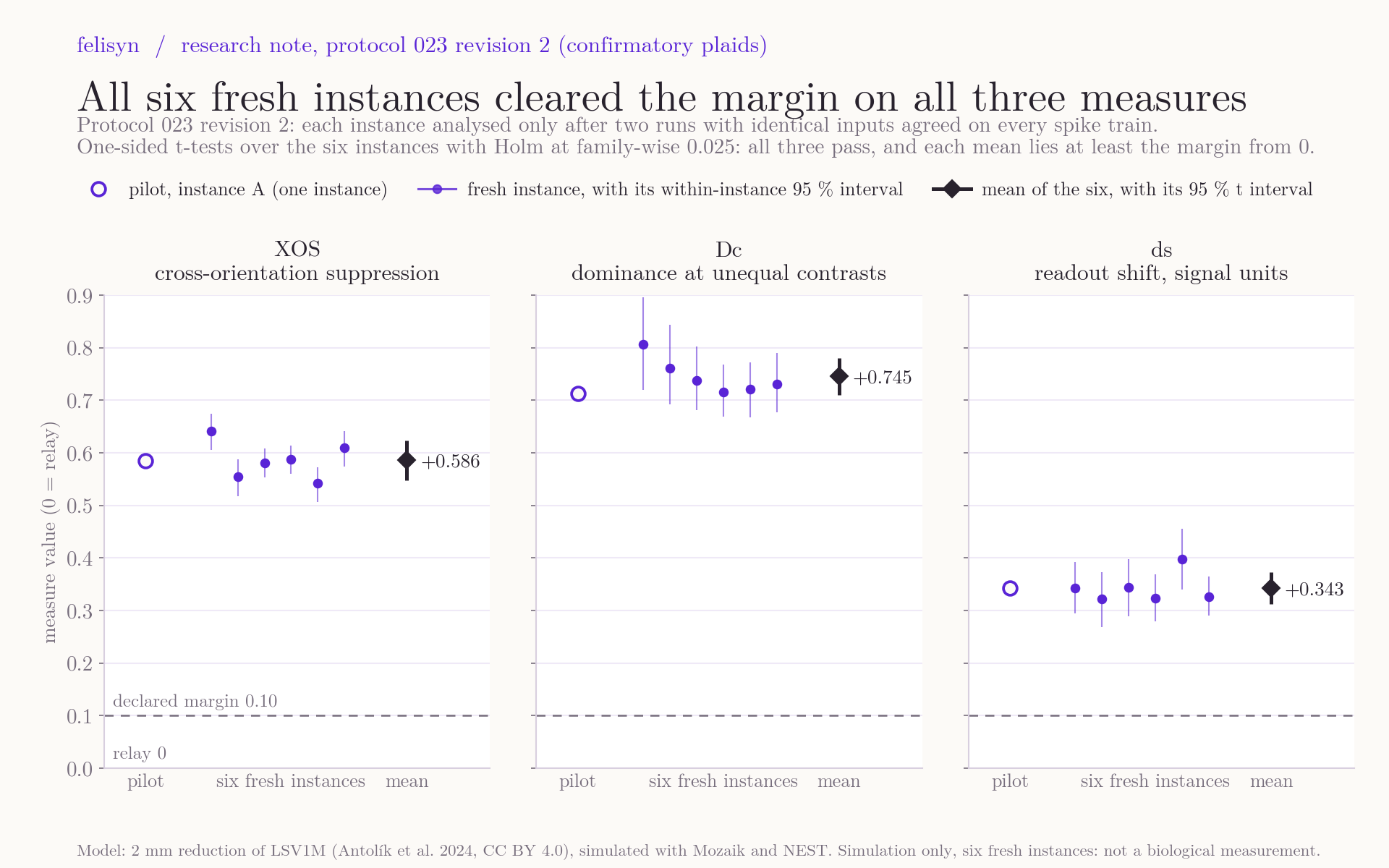
The question and the measures were the pilot's, unchanged: suppression by an orthogonal grating (XOS), dominance of the stronger grating at unequal contrasts (Dc) and the shift of the frozen readout toward the stronger grating (ds), each exactly 0 for a relay, each required to pass a one-sided t-test over the instances with Holm's correction at a family-wise 0.025 and to lie at least the declared margin of 0.10 from 0.
The paired rule
Note 24's fault had a shape: a run of this laptop can differ from an exact repeat of itself, rarely and in one place, and the first attempt's lead-in check could only see such a fault in the 504 ms before the first grating. The owner chose the strictest of the options note 24 listed: every network instance is run twice with identical inputs, and it is analysed only if the two runs agree on every one of the 18,600 neurons' spike trains and on every field of the export but the run name and the run time, with both blind checks passed and the same. A disagreement starts a third run, and if needed a fourth, to find an agreeing pair; a refused export is a one-off fault unless an agreeing pair repeats it; a seed that cannot form a pair falls to the reserve. That doubles the simulation time, and it catches a one-off fault anywhere in the output, not only in the lead-in.
Revision 2 was declared on 11 November at 00:55:21 UTC, before any of its runs, with its spec's SHA-256 recorded in the project's running record at the declaration. The declared text is published in protocol-023r2-public, with 27 home folder paths redacted; its frozen manifest, published byte for byte, pins the spec at the recorded hash, b7072b0b…3af980, and the queue's launch record names that manifest, as with protocol 023's design in note 24. The design was frozen at 09:57:37 UTC with every test passing, and the queue started 74 seconds later.
What ran
The queue ran just under 38 hours, from 09:58:51 UTC on 11 November to 23:54:28 UTC on 12 November, and ended rc=0: 29 attempts, 14 completed runs, six instances settled by an agreeing pair.
- Slots 8 and 10 to 13 settled in pairs: s8 on attempts 1 and 3, s10 on 3 and 4, s11 on 1 and 2, s12 on 1 and 2, s13 on 1 and 3.
- Slot 9 fell to the reserve. All nine of seed 9's attempt names were consumed by stops at the declared 3 GiB disk floor, with zero completed runs, while another program on the laptop filled the disk. The queue absorbed each stop as declared (not counted, wait for disk, retry), settled s9 "attempts used up" and gave the slot to the reserve, seed 14, under the declared replacement rule. From then on no slack remained: every remaining seed had to settle valid, and all did. Fifteen attempts in all were lost to disk-floor stops (nine on seed 9, two on seed 10, four on seed 14); none is counted, and all have receipts.
- The paired rule caught two one-off faults, among the 14 completed runs. s8-a2 passed the blind check, but its cortical spike trains differ from a1's from 541.4 ms on: a fault outside the lead-in, invisible to the first attempt's check, caught only because two runs had to agree on every spike. s13-a2 was refused by the blind check itself, on the fault class that ended protocol 023 (1,799 of 1,800 X_ON lead-in trains identical to the reference). Each cost one extra run; in both cases the third run agreed with the first on every train. The declared S15 record reports 2 faulty runs in 14 completed, a share of 0.14 (95 % interval 0.018 to 0.43) that the spec says runs low.
- No seed needed a fourth completed run, no run was killed for memory, and no agreeing pair was refused.
The analysis then ran once, from the frozen package, right after the queue: fetch, blind checks of the six exports to analyse (the earlier run of each agreeing pair, all VALID, computed twice), the summary, and analyze_confirm_023.py, computed twice and written only when both computations agree.
The result
The declared CONFIRMED text, as the analysis wrote it:
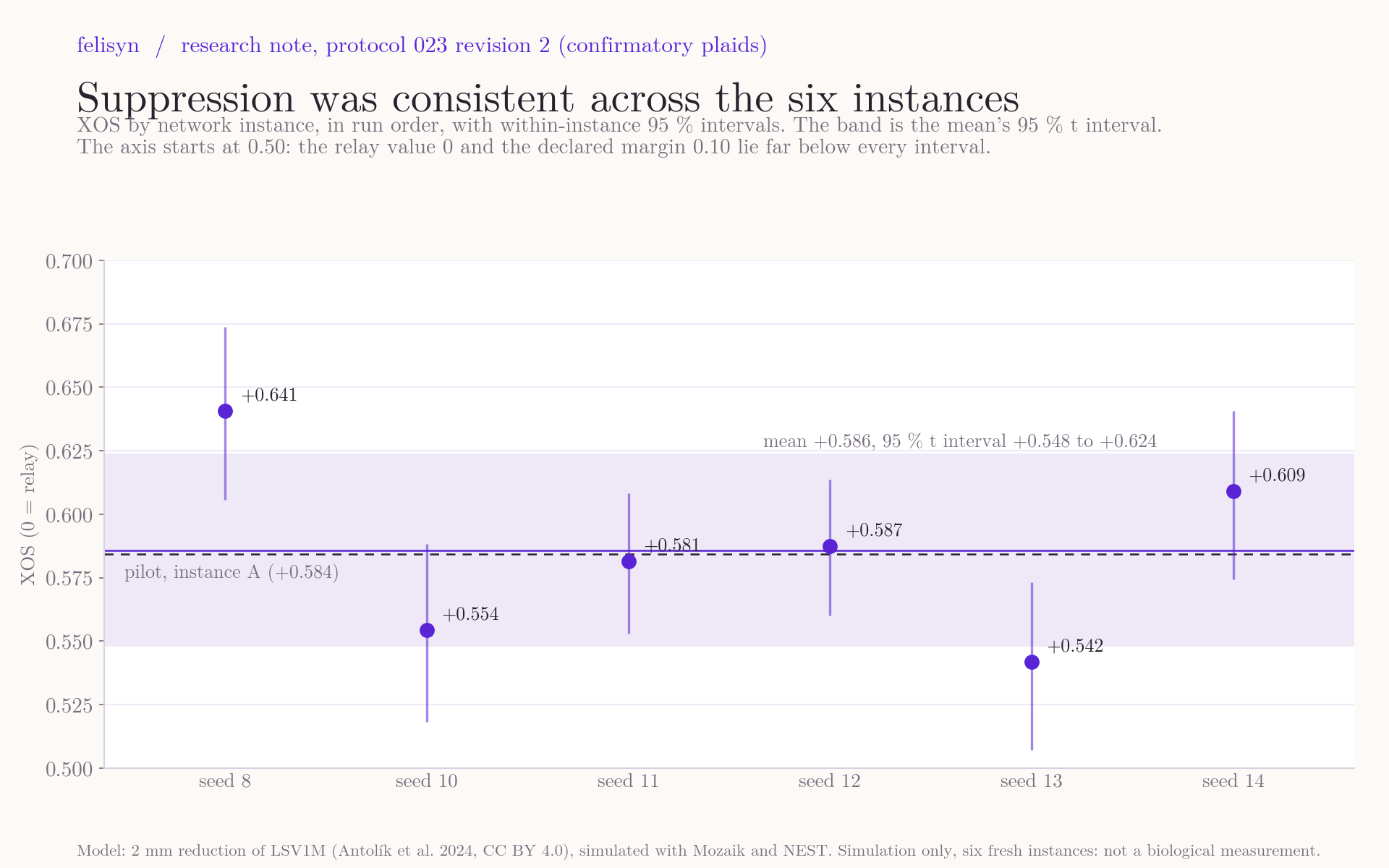
On six network instances of the same 2 mm model that had never been built (pynn_seed 8, 10, 11, 12, 13 and 14: new cell positions and connections, each with its own stimulus order), the intact circuit combined two superimposed gratings differently from a relay of its own single-grating responses, on average over the instances, in the direction instance A's pilot found: an orthogonal grating lowered layer 4 cells' response to their preferred grating below the sum of their single-grating responses (cross-orientation suppression), mean XOS 0.586 (95 % t interval 0.548 to 0.624; one-sided p below 0.0001; instance values 0.641, 0.554, 0.581, 0.587, 0.542 and 0.609); at unequal contrasts the cells preferring the stronger grating kept more of their single-grating response than those preferring the weaker one (winner-take-more), mean Dc 0.745 (95 % t interval 0.710 to 0.781; one-sided p below 0.0001; instance values 0.806, 0.761, 0.737, 0.716, 0.720 and 0.731); the controller's frozen readout of a plaid of gratings 45 degrees apart pointed further toward the stronger grating than the sum of its readouts of the two gratings, by a mean of 0.343 signal units (95 % t interval 0.313 to 0.373; one-sided p below 0.0001; instance values 0.342, 0.322, 0.344, 0.323, 0.398 and 0.327). For each confirmed measure the one-sided t-test of the six instance estimates passed Holm over the three measures at a family-wise level of 0.025, and the mean of the six estimates is at least the declared margin of 0.10; that is a condition on the estimates, not an interval. The instances share the model's one orientation map, its LGN noise stream and its plaid layout, and these contrasts, this timing and this readout, so the result covers new positions and wiring on that map only. It describes the whole circuit, input stage and cortex together, and does not show that the intracortical connections compute it. Simulation only; no claim about cat visual cortex.
The spec asks that two limits be printed beside any outcome text of this protocol. First: the server half of the seed search ran with round 3's script on 3 November 2026 at 00:29:38Z, the final script ran only on the Mac, and the server's files can no longer be read. Second: each analysed instance's export was one of two runs with identical inputs that agreed on every spike train, and S15 gives the share of completed runs that disagreed with their instance's agreeing pair, an estimate of the one-off fault rate that runs low.
Beside the pilot, measure by measure:
| Measure | Pilot (instance A) | The six instances (seed order) | Mean | 95 % t interval |
|---|---|---|---|---|
| Suppression, XOS | +0.584 | 0.641, 0.554, 0.581, 0.587, 0.542, 0.609 | +0.586 | +0.548 to +0.624 |
| Dominance, Dc | +0.713 | 0.806, 0.761, 0.737, 0.716, 0.720, 0.731 | +0.745 | +0.710 to +0.781 |
| Readout shift, ds | +0.342 | 0.342, 0.322, 0.344, 0.323, 0.398, 0.327 | +0.343 | +0.313 to +0.373 |
On every measure, all six instances lie on the pilot's side of 0, and the pilot's own values sit inside or beside the new intervals: the pilot was not an outlier of its model.
What this does and does not show
This is a simulation result on the model circuit, now confirmed over instances. It is not a paper reproduction, not a biological validation and not a controller test, and those categories stay separate in this project.
- It describes the whole model circuit, the input stage and the cortex together, as the declared text says. The input stage is non-linear and shared, so the result does not show that the cortex's own connections compute the suppression or the dominance. That question has its own declared follow-up (below).
- The instances share the model's one orientation map, its LGN noise stream and its plaid layout, and these contrasts, this timing and this readout. "Six fresh instances" means new cell positions and wiring on that map, nothing more.
- Simulation only. In the declared text's words: "no claim about cat visual cortex." Nothing here is biological validation.
- A confirmed ds changes no controller. The readout was applied offline. A controller fed two signals at once would still need its own declared encoder, as the declared next-step text says.
Limits
The spec states nine limits of the laptop run and asks that they stand beside every result of this protocol. In short: a new platform (arm64 macOS, not the pilot's x86-64 Linux); two engine patches, the LGN noise pair order and a NEST block size; a memory wrapper around the unchanged runner; both blind checks on one machine, under two Pythons, so a fault of this machine could show in both; the server half of the seed search, quoted above; identity with the pilot resting on the tiny regression and G4, one instance on one sequence; one shared laptop on a nearly full disk, which cost 15 attempts and one slot here; G4 showing exact reproduction of the pilot, not that a fresh seed behaves; and one-off faults at a poorly known rate, which the paired rule catches anywhere in the export but cannot catch if the same fault struck both runs of a pair identically (an argument, not a measurement, puts that below about 1 in 700,000 under the leading untested candidate), if a fault is deterministic for an instance, or if it struck both computations of a check the same way. The package README gives the full statements.
Two more, beyond the spec's list: the between-instance intervals rest on six values, so they are wide relative to the within-instance ones; and the cause of the laptop's one-off faults is still untested, so the paired rule treats the symptom, not the cause.
What went wrong on the way
- The first tier 2 attempt failed on a harness count kept from protocol 023 (it expected eight instance files; revision 2 declares seven). Every component check passed; the two-line fix is recorded with the package, the contract does not pin that file, and the second attempt passed.
- The first freeze attempt was refused by its own rule: the deliberate-break tool's baseline mirror lacked revision 2's seed search record. All 13 test files had passed; after a one-line fix the second freeze ran every test and all 278 deliberate breaks, in 7.8 hours under the other task's load, and passed.
- Slot 9 was lost to disk-floor stops, as above; the queue absorbed them as declared, at the cost of the reserve.
Next
- The conductance follow-up declared in protocol 022, on the connection lists that pilot exported: rebuilding offline the synaptic input each layer 4 cell received, to estimate how much of the suppression the input stage carries. That is the declared route to the question this result leaves open, what the cortex's own connections compute, and it cannot change this outcome.
- The controller line resumes. Note 20's decision protocol and the controller design work that waited on this confirmation can go on, in their own declared protocols, with tokens still simulated.
Status on 13 November: the follow-up has not started, and no new protocol has been declared.
Evidence and sources
- Confirm 023r2: the result package, with:
- the declared results and the analysis's memcap record;
- the blind checks of the six analysed exports and the summary by the paired rule;
- the queue's 597 receipts, among them the queue log, the replacement record, the pair comparisons with the two fault records (s8, s13) and every attempt's times, memory and run-folder hashes;
- the six analysed exports, about 145 MB, published byte for byte, with every completed export's SHA-256;
- the figures with their data and scripts, and the manifest.
- Protocol 023 revision 2, public copy: the frozen design, with the declared spec, the frozen manifest, the paired-rule comparison and the checker. Twenty-five of its files have recorded replacements, listed in its README.
- Note 24, the first attempt's early stop and diagnosis, with early-stop-023.
- Note 22, the pilot, with plaids-022.
Model: Antolík et al. (2024), CC BY 4.0; LSV1M v1.0 (MIT); Mozaik v0.4.0 (CeCILL); NEST 3.4 (GPL); the NEST step current module, whose patched files state the GPL; PyNN 0.11.0 (CeCILL); GSL 2.7.1 (GPL). The protocol, the runs, the comparisons, the checks and the figures are ours. The patches are offered under the terms of the files they change.