What the suppressed cells received: the declared conductance follow-up
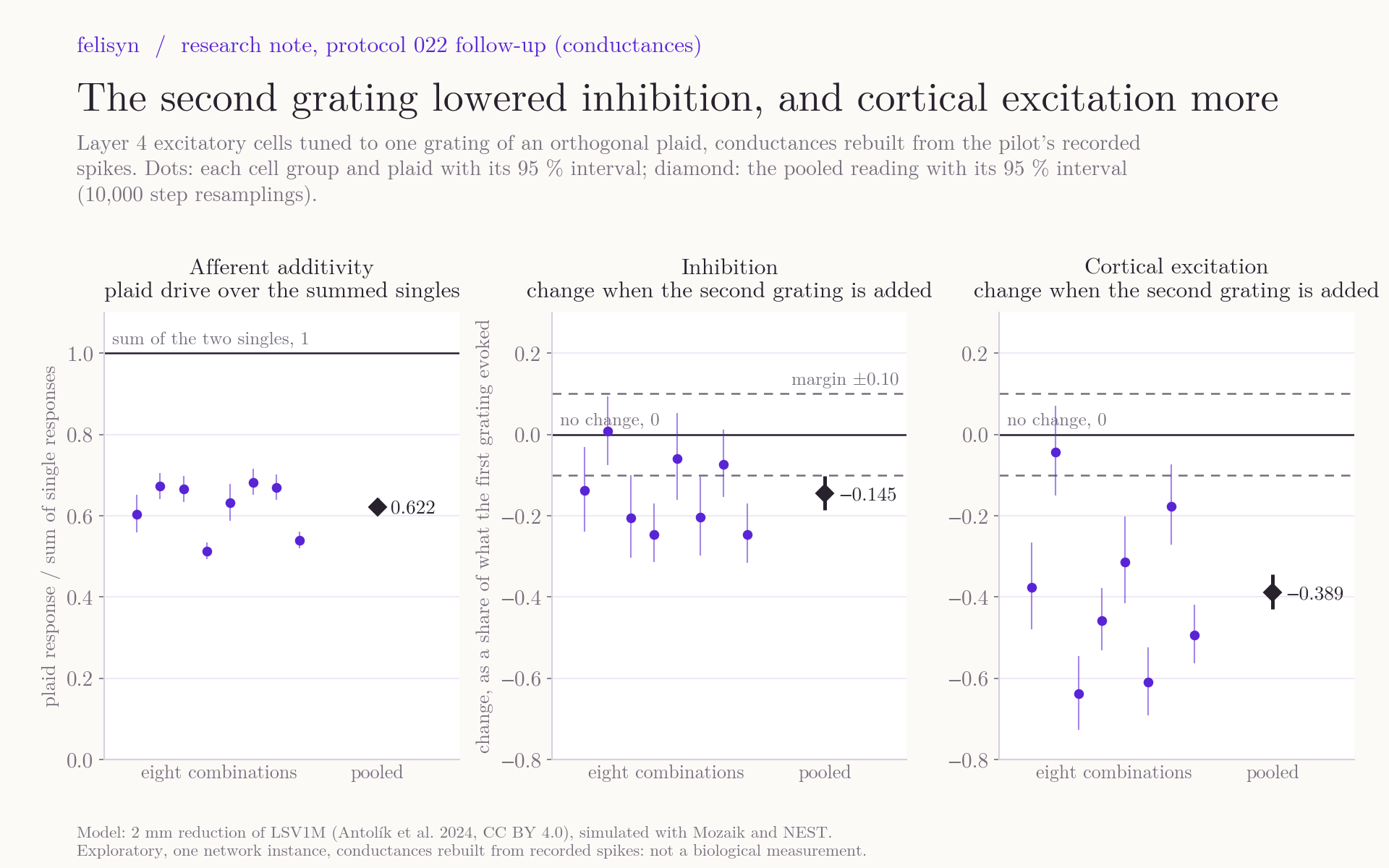
Protocol 022 declared a follow-up before its pilot ran: rebuild, offline, the synaptic conductances each layer 4 cell received, after proving the rebuild on earlier runs. The replay passed all three declared validations on its first recorded attempt, reproducing more than 99.99 % of spike counts. The readings, exploratory by declaration and on one network instance: when a second, orthogonal grating is added, inhibition onto cells tuned to the first grating falls by about 15 % of what the first grating evoked, the opposite of the direction asked about, and excitation from other cortical cells falls by about 39 %. The declared reading of the input stage could not answer its question: the mean input from the LGN turned out not to depend on orientation. One declared count did not fit the declared stimulus set and was amended before any of the pilot's recorded spikes were read. The conductances are rebuilt from recorded spikes, so these readings describe the suppressed state and do not show its cause. Simulation only.
Note 25 confirmed, over six fresh network instances, that the 2 mm cat circuit model does not answer two superimposed gratings with the sum of its answers to each alone. It also said what that result leaves open: it describes the whole model circuit, input stage and cortex together, and does not show what the cortex's own connections do.
Protocol 022 had declared a follow-up for that question on 26 October, before its pilot ran: rebuild offline, from the recorded spikes and the exported connection lists, the synaptic conductances each layer 4 excitatory cell received, and read three things from them. This note reports that follow-up. It is exploratory by declaration, it uses the pilot's one network instance, and it cannot change any outcome.
In short: the rebuild passed every declared validation at the first recorded attempt. In the suppressed state, cells tuned to the first grating receive less inhibition than with that grating alone, and much less excitation from other cortical cells. The reading meant to say how much of the suppression is already in the input from the LGN could not say it.
What was declared
The model records spikes, not the synaptic input behind them. The declared route to that input was a replay: give a copy of the layer 4 excitatory cells exactly the spikes their presynaptic cells fired in the original run, through the exported connection lists with the simulator's own synapse and cell models, and let them run open loop. If the copy then fires as the original cells did, the conductances inside it are the ones the original cells received.
The declared text fixed the rules beforehand:
- Blinded development. The replay is developed and validated only on runs of the earlier protocol 017, in at most three recorded attempts, before it reads any pilot export.
- Three validations, each with the same four criteria, the first 300 ms of each presentation excluded:
- spike counts per cell and step identical in at least 98 % of cases, in two windows;
- group mean counts within 1 % in every step;
- at least 90 % of recorded spikes with a replayed spike within ±0.2 ms;
- total spike ratio between 0.99 and 1.01.
- V1 replays 017's feedforward-only run, V2 its intact run with all five kinds of connection onto the cells, and V3 the pilot's own lesion run.
- Three readings, each licensed only by the validations it depends on: the afferent additivity (needs V1 and V3), and the changes of inhibition and of cortical excitation (need V2).
The replay passed at the first attempt
Before any declared attempt was spent, the method was tried on a small network built for the purpose, with the model's cell and synapse types: 60 excitatory and 20 inhibitory cells in a closed loop, recorded once and then replayed open loop. The replay reproduced all 60 excitatory spike trains exactly. Two deliberate errors, a delay wrong by 0.1 ms and a wrong synaptic recovery time, left 1 and 12 of the 60 trains identical and failed the criteria, so the test can fail.
One recorded attempt then covered all three validations, with the replay tool unchanged between them and its file hashes checked at each start. (An attempt was defined, in the gate written after V1 passed and before V2 ran, as one version of the replay code taken through validation.) Each replay was computed twice, and the two had to be equal.
| Validation | Recorded spikes | Counts identical (needs 98 %) | Worst group deviation (at most 1 %) | Spikes matched within ±0.2 ms (needs 90 %) | Spike ratio (0.99 to 1.01) |
|---|---|---|---|---|---|
| V1, 017 feedforward-only | 12,260,678 | 99.997 % | 0.017 % | 99.972 % | 1.00002 |
| V2, 017 intact | 1,695,598 | 99.9994 % | 0.22 % | 99.994 % | 1.00002 |
| V3, pilot lesion | 7,815,513 | 99.995 % | 0.024 % | 99.964 % | 1.00003 |
All three passed, so all three readings were licensed. Two of the three declared attempts were never used.
The conductance code, the readings code and their tests were written while V1 and V2 ran, tested without the pilot's recorded runs, read once by an independent reviewer (12 findings, none high, all applied; the review itself is not published) and frozen with a hashed manifest before the first of the pilot's recorded runs was opened for V3. The connection lists are the exception to "no pilot data": they were exported by the pilot's own runs, describe the same network instance as protocol 017's runs, and the replay needed them from V1 on. The readings were then computed twice from the frozen code, and the two result files are byte-identical. As an integrity check, the spike-based suppression index recomputed inside the readings code is 0.584392, the pilot's published value.
An amendment, made blind
The declared text says a reading is a mean over "the 12 group-and-plaid combinations" and needs "at least 9 of its 12". That count does not fit the declared stimulus set. According to the unpublished design draft, an earlier version had six orthogonal plaids and two cell groups, which makes twelve; the declared revision cut the plaids to four and kept the old counts in this paragraph. Two cell groups times four plaids is 8 combinations.
There is a literal way to reach twelve: the declared text names three cell groups (45°, 90° and 135°), and three groups times four plaids is 12. That reading was not taken. The 90° group has no test grating in a plaid of 45° and 135°, so the two conductance-change readings are undefined for it; they could reach 8 of 12 at most and could never be made. The afferent additivity could have been computed for the 90° group as well. It was kept to the same two groups, which is a choice.
The amendment, written down before any of the pilot's recorded runs was opened: a reading needs at least 6 of its 8 combinations, the same three quarters. Each of the three combination readings carries this note in the result file, and says that under the literal count it would not be made. In the event all 8 of 8 combinations counted for each reading, so the threshold decided nothing. The readings still rest on an amended rule, and a reader who holds to the literal text should treat them as not made.
The readings
All three are for layer 4 excitatory cells preferring 45° or 135°, in the window from 20 to 230 ms after stimulus onset, with intervals from 10,000 resamplings of whole steps.
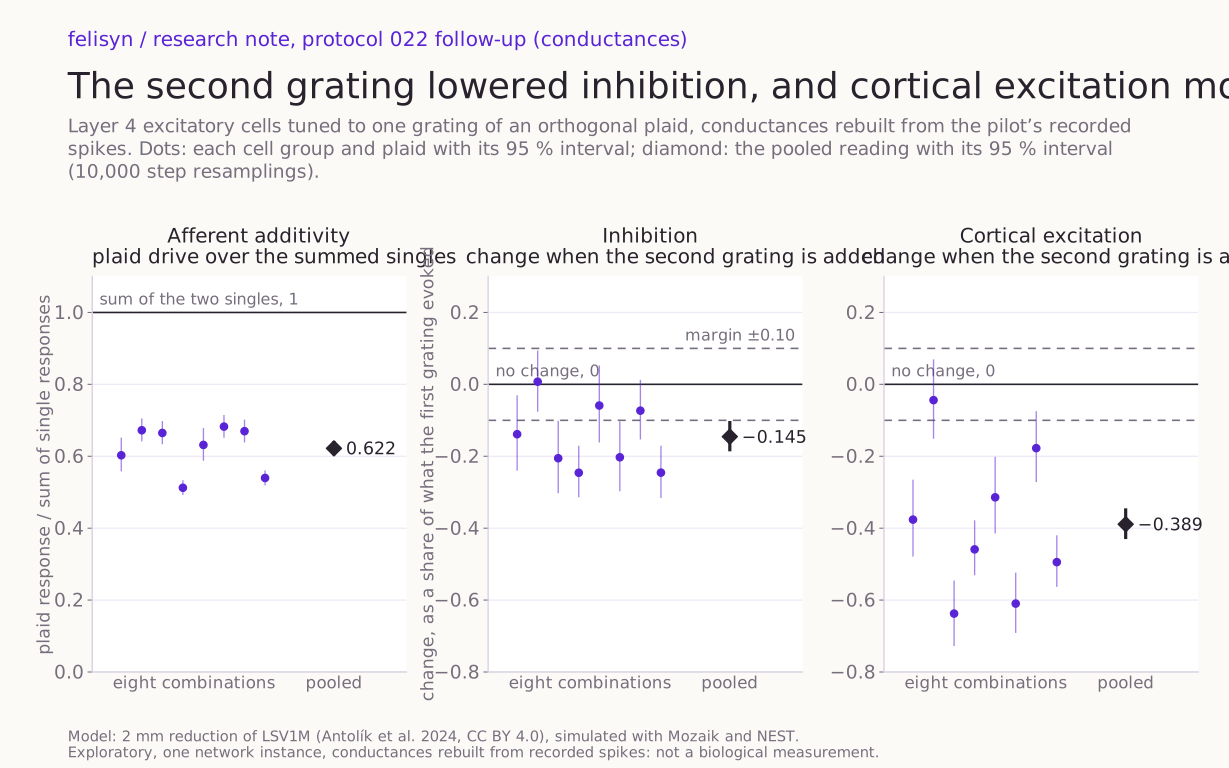
Inhibition fell (m_I = −0.145, 95 % interval −0.186 to −0.102). The declared question was whether the second grating raises the inhibition onto cells tuned to the first. In the pooled reading it does not. It lowers it, by about 15 % of what the first grating evoked, beyond the declared margin of 0.10 in the opposite direction. The eight combinations vary: one is slightly positive (+0.007), and three of the eight intervals include zero.
Cortical excitation fell more (m_E = −0.389, −0.430 to −0.345). The declared question was whether the second grating lowers the excitation these cells receive from other cortical cells. It does, by about 39 % of what the first grating evoked; one of the eight intervals includes zero. Both pooled readings pass Holm's correction over the two at 0.05.
The afferent additivity is 0.622 (0.603 to 0.642). The mean conductance a plaid evokes from the LGN is 62 % of the sum of what its two gratings evoke alone. This reading is identical in the intact and the lesion run, to the last digit, as it should be: the two runs share every LGN spike.
What the afferent reading could not say
The follow-up was designed to estimate how much of the suppression the input stage already carries. The declared way was to compute the suppression index on the afferent conductance and compare it with the index on the spikes. Protocol 022 attached a validity rule to that index: it means suppression only if the orthogonal grating alone barely drives the quantity measured.
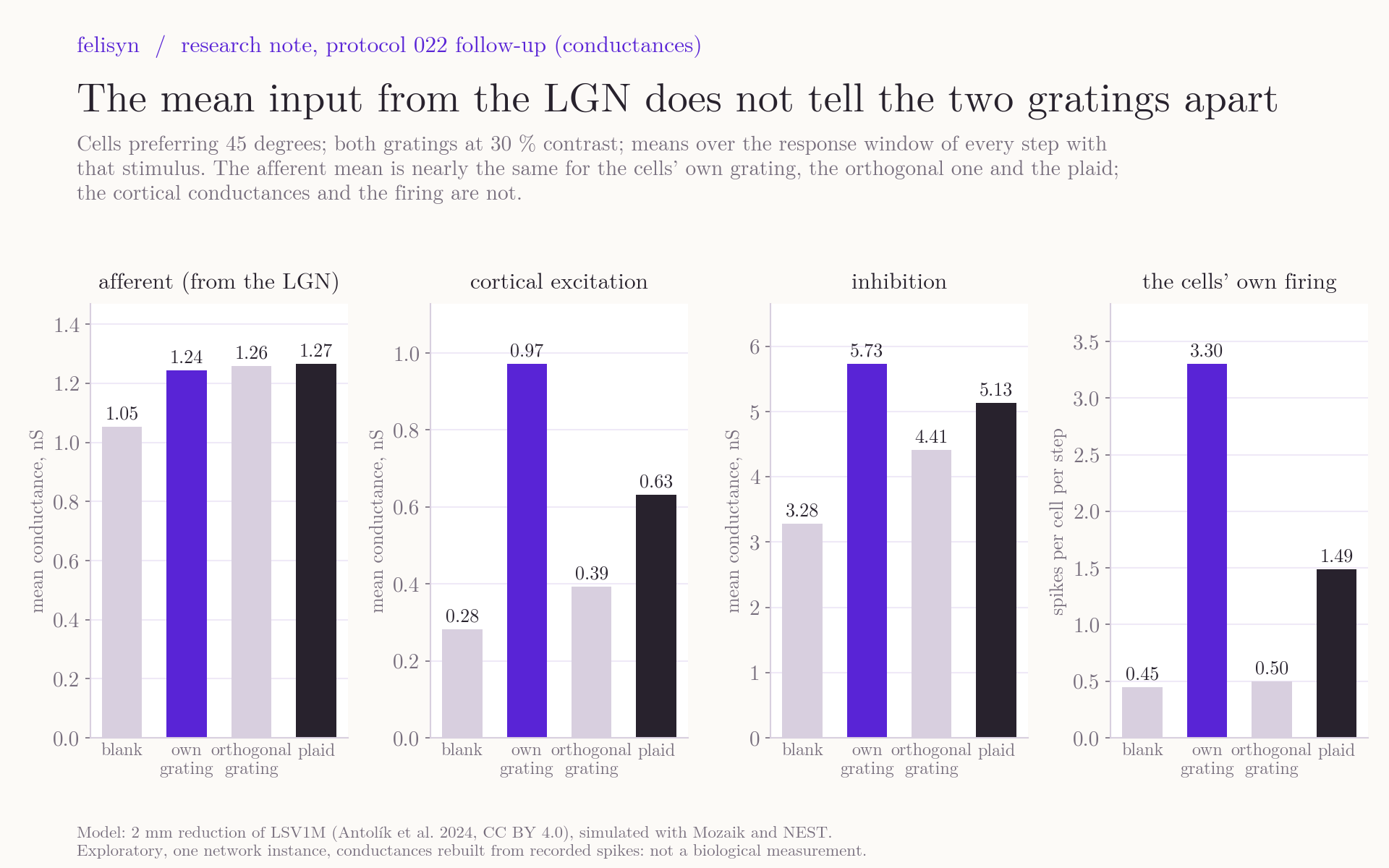
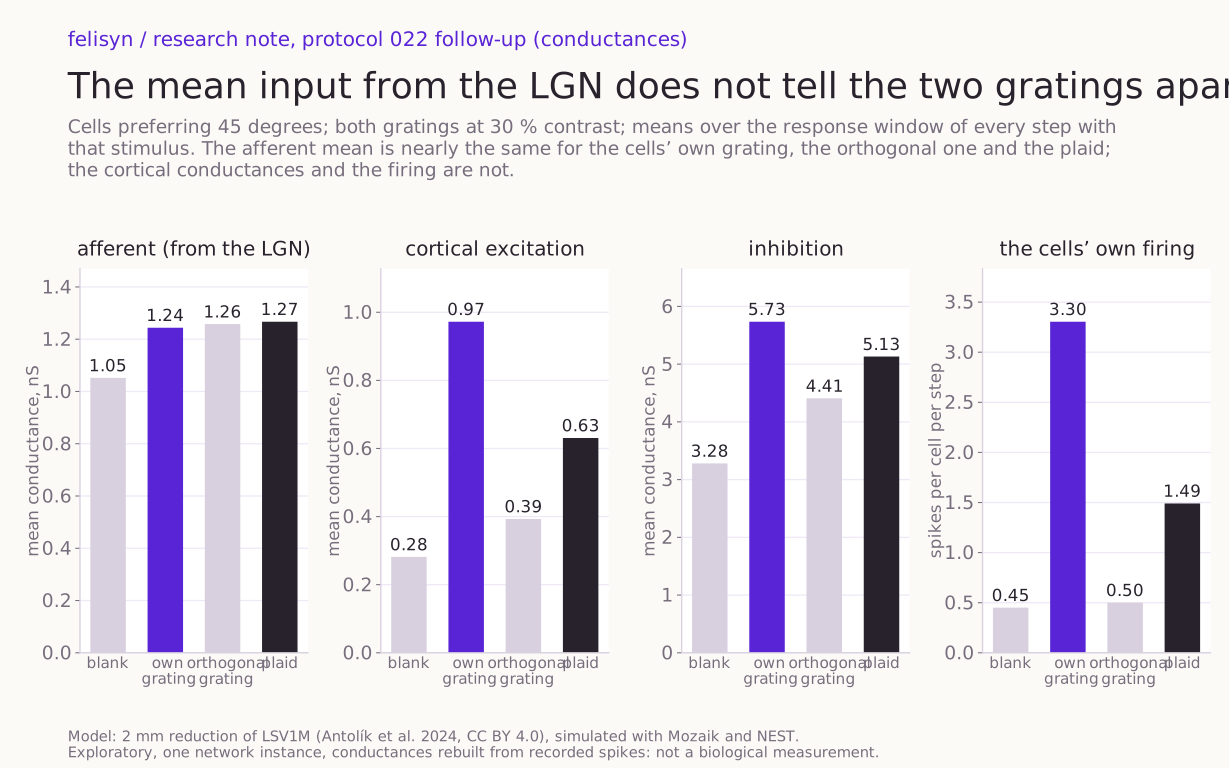
For the mean afferent conductance that rule fails completely. The orthogonal grating drives it as strongly as the cells' own grating: 1.258 nS against 1.244 nS for the 45° group, over a blank level of 1.052 nS. The cross drive is 1.07 for this pair and 1.010 on average over the four own gratings, where the rule allows at most 0.10. The mean input from the LGN, averaged over the window, follows contrast and not orientation. Whatever tells these cells the two gratings apart in their input is something a window mean cannot see, presumably the input's timing within the window. That was not measured here.
So the afferent version of the index, 0.860 (0.810 to 0.909), is reported with the declared caution and is not a suppression index. Its difference from the spike index, −0.275, carries the same caution. The question note 25 left open, how much of the suppression the input stage carries, is not answered here. The declared text calls the afferent additivity "the suppression in the drive layer 4 receives". This note does not read it that way, for the same reason: with an untuned mean, the additivity of 0.622 says that the mean input grows less than additively, since a second grating at the same contrast adds little to it (1.244 nS to 1.267 nS). It does not say that the part of the input these cells respond to is suppressed. That reading is ours, made after seeing the numbers.
What this does and does not show
- It describes the suppressed state. In this model instance, a cell tuned to one grating, shown that grating plus an orthogonal one, sits in less inhibition and much less cortical excitation than with its grating alone, while its mean input from the LGN is about the same (slightly higher in 6 of the 8 combinations).
- It does not show cause. The conductances are rebuilt from the recorded spikes. In this model, layer 4 excitatory cells connect preferentially to cells with similar tuning (Antolík et al. 2024), so when those cells fire less, each receives less cortical excitation: the fall of m_E is at least partly a consequence of the suppression and may also amplify it. These readings cannot separate the two.
- It does not rule inhibition out. Mean inhibition is lower with the plaid than with the first grating alone, but still well above the blank level (5.13 nS against 3.28 nS), and the balance and the timing of excitation and inhibition were not read.
- It is one network instance, the pilot's instance A.
- It is exploratory, with one declared count amended. It changes neither the pilot's outcome nor the confirmation in note 25.
- It is simulation only, and no claim about cat visual cortex.
Limits of the method
The validations show that the replayed cells fire as the recorded ones did, with at most about 5 in 100,000 cell-and-step counts differing. They do not prove each conductance trace separately: the offline conductance code was checked against the simulator's own recorded conductances on a test network and agreed to better than one part in a million, but in the model runs themselves no conductance was recorded to compare with. The replay and the readings ran on the laptop described in note 23, which can make rare one-off execution faults (notes 24 and 25); every replay and the readings were therefore computed twice and compared. One earlier look at pilot data is disclosed in the package: the first 3,000 characters of the pilot's intact export, its header with the run time, the command line and the resolved seeds and weights, were printed to learn the file layout before the freeze existed. No spike time, count or measure was read.
Next
- The controller line resumes under its own declared protocols: what the circuit's response to a stimulus can drive, on the result notes 22 and 25 established.
- The input-stage question stays open. Answering it needs a reading that follows the input's timing within a step, not its mean, and that would be a new declared analysis.
Status on 13 November: neither has been declared.
Evidence and sources
- Conductance 022: the follow-up's package, with:
- the readings, computed twice (second file, byte-identical);
- the three validations: V1, V2, V3, each with the gate written before its run;
- the ground-truth test of the replay method, with two earlier tries kept;
- the frozen code, its manifest and the working record with the amendment and the review's outcome;
- the figures with their data and scripts, and the package manifest.
- Protocol 022, public copy, with the declared spec that holds the follow-up's text.
- Note 22, the pilot, with plaids-022; note 25, the confirmation.
Model: Antolík et al. (2024), CC BY 4.0; LSV1M v1.0 (MIT); Mozaik v0.4.0 (CeCILL); NEST 3.4 (GPL); the NEST step current module, whose patched files state the GPL; PyNN 0.11.0 (CeCILL); GSL 2.7.1 (GPL). The follow-up's code, replays, readings and figures are ours.