Three steps did not beat one
Note 28 found that the two-signal rule sometimes holds when one signal leads by only 7.5 points. This note tests one remedy, declared beforehand: show the same pair for three steps in a row and decide from the mean of the three readings. Three new network instances were each built and run at least twice. Declared outcome: PASS, but at the minimum, with the intended action in 75 of 78 scored blocks where at least 75 were needed. The remedy itself did not help: in the 36 close blocks the mean of three steps decided for the stronger signal in 33, and the first step alone did so in 33 as well. Readings did not fade over the three repeats. All three misses were holds on the same side, where signal B led. A reading made after the result, and not declared, suggests a reason: the grey screen's reading lies nearer the B side, so one threshold leaves B less room. Equal signals held in 24 of 24 blocks and clear leads were acted on in 18 of 18. One of seven runs disagreed with its partner and was replaced as declared. Simulation only; no market signal and no action.
Note 28 mapped a rule that turns two simultaneous signals into one of three actions: A, B or hold. The rule passed, but in the cells where one signal led by only 7.5 points it held in 6 of 72 steps. The step announced there was to ask whether a short run of steps removes those holds.
This note reports that test. The declared outcome is PASS, at the minimum: the intended action in 75 of 78 scored blocks, where at least 75 were needed. The remedy under test did not help: one step did as well as three.
It is an engineering rule tested on model runs. No market signal entered and no action was taken.
What was run
The per-step reading is the one of notes 27 and 28, with nothing changed. Signal A is a grating at 45°, signal B one at 135°, each signal's strength its grating's contrast. One number, v, is read from the response of all layer 4 excitatory cells to one step of 210 ms: roughly −1 for A alone at 30 %, +1 for B alone at 30 %.
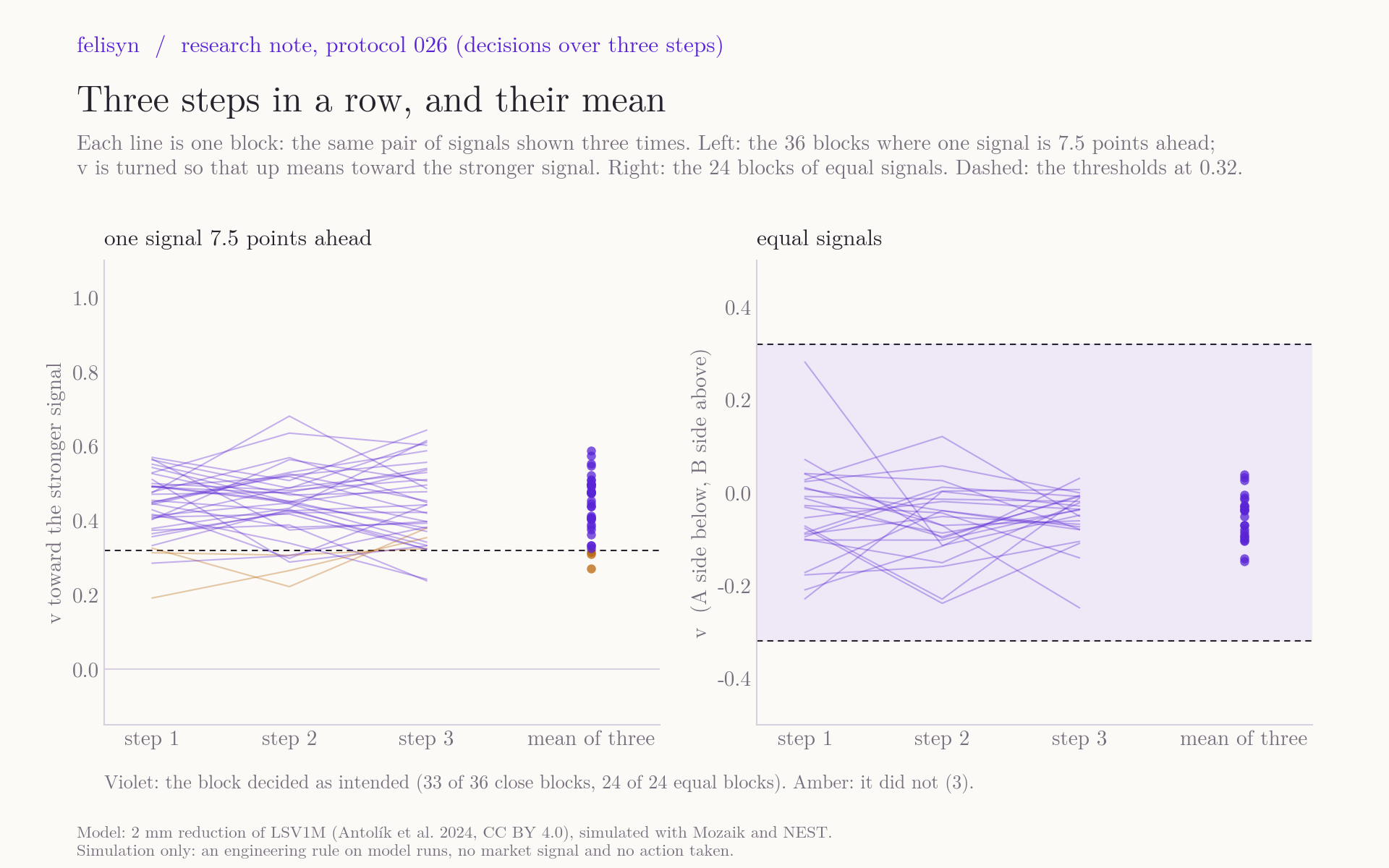
New is the block. The same pair of strengths is shown for three steps in a row, 147 ms of grey screen between them. The block's decision is the action of the mean of its three v: B above +0.32, A below −0.32, hold in between. The threshold is still the one fixed for note 27.
What each instance saw. 28 blocks and 24 single calibration steps, in an order drawn per instance:
- 12 close blocks: the six pairs whose strengths differ by 7.5 points, twice each. Intended: the stronger signal's action.
- 8 equal blocks: 7.5, 15, 22.5 and 30 % on both signals, twice each. Intended: hold.
- 6 clear blocks: one signal alone at 15 %, or ahead by 15 points. Intended: the stronger's action.
- 2 weak blocks: one signal alone at 7.5 %. Described, not scored.
What counts was declared beforehand. The frozen files were hashed and recorded at 10:07:26 UTC on 21 November; the first run started nine seconds later. PASS if every instance takes the intended action in at least 24 of its 26 scored blocks and the three together in at least 75 of 78.
The declaration also said what a PASS would not show. The rule and the block length were chosen on note 28's published data. From those counts, the pass marks would be met about 63 times in 100 even if three steps were no better than one. So the declaration named a comparison inside the same runs: the decision each block's first step would have given alone. It also named the risk in the other direction: a repeated stimulus might give a fading reading, which could have produced a FAIL.
The instances are new. Seeds 18, 19 and 20 were built for this test. As since note 25, each instance was built and run twice and counts only if the two runs agree on every spike. Seven runs were made. Instance 18's first two runs disagreed; the declared third run equalled the first on all 7,873,595 spikes, so the first was analysed. The other two instances agreed at once. No run failed, and the reserve instance was not needed.
The result
PASS: 26, 25 and 24 of 26 blocks, 75 of 78 in all. The tool ran twice and the two result files are byte-identical. Two of the three pass marks were met exactly: one more held block would have given FAIL.
| Kind of block | Intended | Blocks as intended | Single steps as intended | Mean v of a block |
|---|---|---|---|---|
| Close, A ahead by 7.5 | A | 18 of 18 | 54 of 54 | −0.59 to −0.45 |
| Close, B ahead by 7.5 | B | 15 of 18 | 43 of 54 | +0.27 to +0.45 |
| Equal | hold | 24 of 24 | 72 of 72 | −0.15 to +0.04 |
| Clear | the stronger's | 18 of 18 | 54 of 54 | −0.93 to −0.67, +0.50 to +0.74 |
- Equal signals always held, and clear leads were always acted on, in every block and in every single step.
- The three misses are all holds where B led: A 22.5 with B 30 in two instances (means +0.315 and +0.309, against a threshold of +0.32) and A 15 with B 22.5 in one (+0.270).
- No block and no step took the weaker signal's action.
Three steps against one
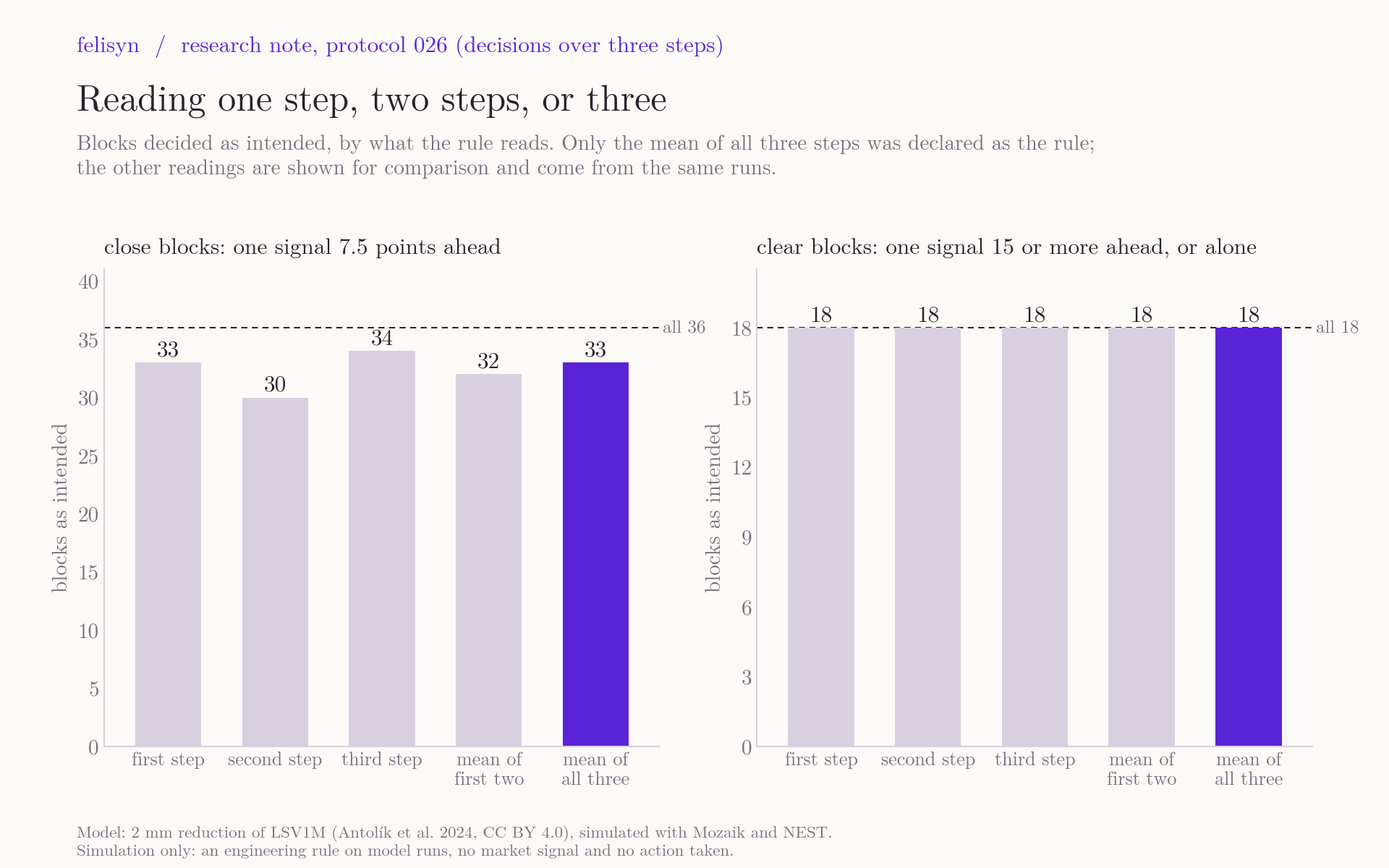
In the 36 close blocks, the mean of three steps decided for the stronger signal in 33. The first step alone did so in 33 as well. The second step alone gave 30, the third 34, and the mean of the first two 32. These differences are one to three blocks out of 36 and are not distinguishable from each other; what they do not show is a gain from averaging.
What averaging did in the three missed blocks. Averaging removes scatter between steps; it helps a block in which one step dips and hurts one in which only one step peaks. The three missed blocks read +0.31, +0.31, +0.32; then +0.33, +0.22, +0.38; then +0.19, +0.27, +0.35. The first sat at the threshold in every step. In the second, the first step alone would have acted and the mean turned it into a hold. The third rose over the block. Their means are 0.005, 0.011 and 0.050 short of the threshold. When the typical reading of a pair lies this close to the threshold, the mean of three lands on either side about as often as a single step does.
Readings did not fade over the repeats. Over all close blocks the mean v toward the stronger signal was 0.441 at the first step, 0.441 at the second and 0.440 at the third. Single instances moved a little in both directions (from 0.44 to 0.41 in instance 19, from 0.44 to 0.48 in instance 20). The risk named in the declaration did not appear at this timing.
The two sides are not symmetric
This reading was made after the result and was not declared.
The misses are all on the B side, and the calibration steps show a reason. By construction, the calibration means of A alone and B alone at 30 % differ by exactly 2. If the grey screen's reading lay midway, they would be −1 and +1. They were −1.04 and +0.96 in instance 18, −1.10 and +0.90 in instance 19, and −1.14 and +0.87 in instance 20. The grey screen's reading lies nearer the B side, so one threshold of 0.32 leaves B less room than A. The equal blocks lean the same way (means from −0.15 to +0.04), and the two instances with the larger offset are the two with misses. Three instances cannot establish that pattern.
Note 28's map shows the same lean: its holds in the transition zone were 4 on the B side and 2 on the A side, and A alone at 7.5 % acted more often than B alone.
Scaling each side by its own calibration response would, on these same runs, have decided 35 of the 36 close blocks for the stronger signal, kept all 24 equal blocks at hold and all 18 clear blocks as intended. The first step alone, scaled the same way, also gives 35 of 36, so this too shows no gain from three steps. It is arithmetic after the fact on the data that suggested it: a candidate for the next declared test, not a result.
What this does and does not show
- The rule passed again on fresh instances, narrowly. Equal signals and clear leads were decided as intended in all 42 blocks; the close blocks carried all the risk and three of 36 held.
- Showing a pair three times did not reduce the holds. This is one block length and one way to combine steps. Longer blocks or other combinations were not tested.
- The first step is a within-run baseline, not a repeat of note 28. It often follows a three-step block of another pair, a context note 28's single steps never had.
- It is three instances with 12 close blocks each. With 33 of 36, the share of close blocks decided for the stronger signal is compatible with anything from about 78 % to 97 % at the 95 % level, if the blocks are treated as independent. They are not quite: they come from three instances, with each pair shown twice.
- A decision over three steps costs three times the model time (1.07 s instead of 0.36 s) and here bought nothing.
- It does not show that the cortex's own connections make the decision. No runs without them were made. The rule reads the whole model, input stage and cortex together.
- It is narrow. One pair of orientations, one timing, one orientation map shared by all instances, strengths up to 30 %, calibration from single steps of the same run.
- One of seven runs differed from its partner. The paired rule exists for this: a run counts only with an identical twin. Instance 18's second run differed from its first; the third matched the first exactly. Notes 24 and 25 reported three such one-off differences before this one; the cause is not known.
- It involves no market and no action, and it is simulation only: no claim about cat visual cortex.
Next
- A threshold for each side. Declare a rule that scales the A side and the B side by their own calibration responses, and test it on fresh instances against the rule used here.
- A third input. Note 27 found that a stronger grating at another orientation masks a weak signal. A controller needs either a guard against that or a declared behaviour for it.
Status on 21 November: neither has been declared.
Evidence and sources
- Three-step decisions 026: the package, with:
- the declared results, computed twice (second file, byte-identical);
- the declared spec, the tool, its tests, the run queue and the frozen manifest;
- the queue's log and the receipts of all seven runs, with the comparison records of instance 18 (first against second, first against third);
- the analysed export of each instance (18, 19, 20);
- the figures with their data and scripts, and the package manifest.
- Note 28 and decision map 025, whose transition zone this test follows up.
- Note 27 and decisions 024, where the rule and its threshold were fixed.
- Protocol 017, whose readout the rule uses.
Model: Antolík et al. (2024), CC BY 4.0; LSV1M v1.0 (MIT); Mozaik v0.4.0 (CeCILL); NEST 3.4 (GPL); the NEST step current module, whose patched files state the GPL; PyNN 0.11.0 (CeCILL); GSL 2.7.1 (GPL). The rule, its test and the figures are ours.